
Sample reports / Ready-to-drink coffee
Night Watch Vanilla Oat Cold Brew: the full analysis
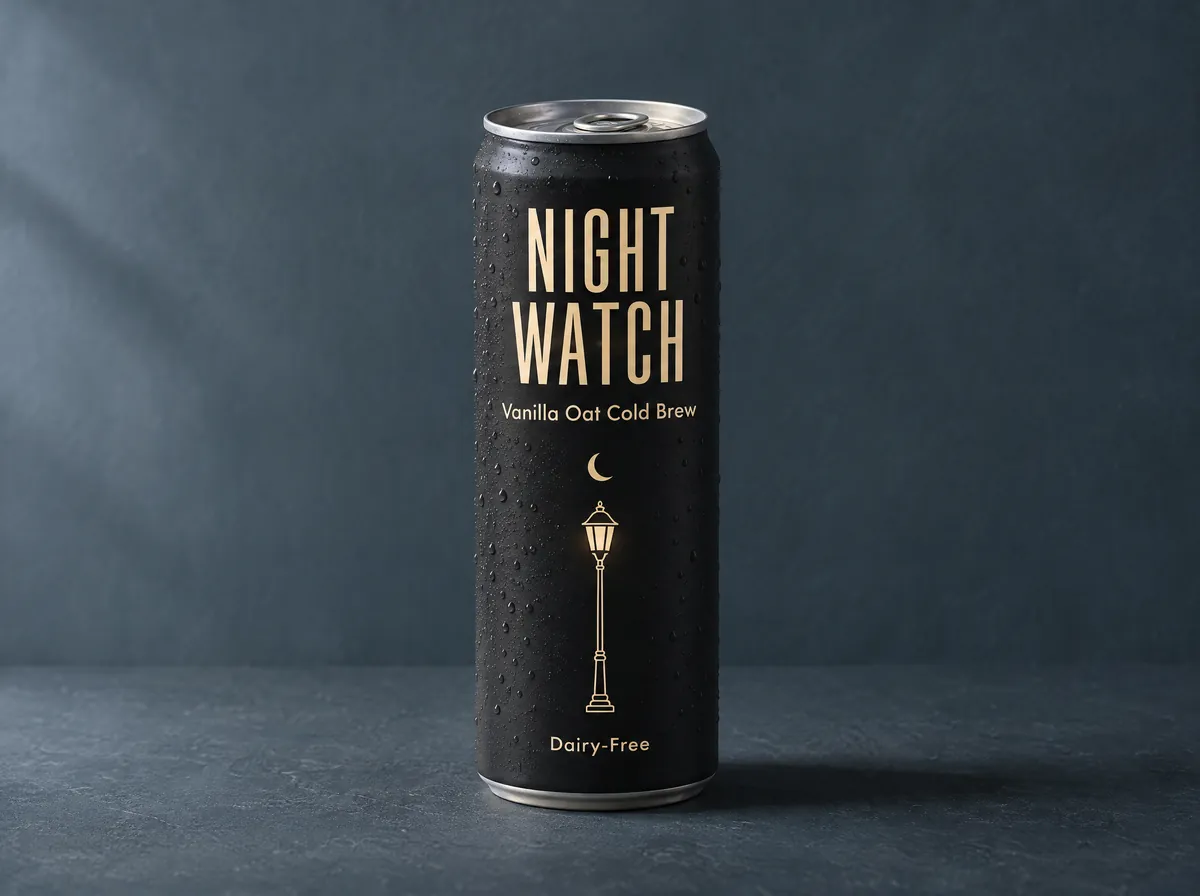
The product, as the founder described it: Night Watch Vanilla Oat Cold Brew is a lightly sweet, dairy-free RTD cold brew for late-shift workers and early-morning commuters who want café-quality coffee without the coffee shop detour.
What the founder came for: Expand distribution
The short answer
Night Watch has a credible product and one of the more ownable names in ready-to-drink coffee. 140 mg of caffeine with 7 g of sugar in a dairy-free base is a real spec, and the night-shift idea gives the brand a reason to exist that most vanilla oat lattes lack. The difficulty sits in three places that stack on each other: the pack format, the channel you have put first, and the cost structure under both. Club is your primary target, and a single 12 oz glass bottle has no place on a club pallet.
Cash on hand: $420,000, as the founder stated it.
What this is. A complete CPG Canary report, exactly as the product wrote it.
- Night Watch Coffee Co. is an invented brand, made to show the product. Its costs, stage and founder are made up, and its own figures appear as they were entered.
- The competitors named, and any price shown for one, come from live web research on the day of the run. Each price carries a link to where it was found.
- Shelf position is a percentile worked out from licensed grocery channel data.
- Margins and unit economics are computed in code, not written by the AI.
$3.99 target price · Growing brand ($500K-$5M annual revenue) · 5,522 words
Key insights
Club is a plausible buyer for this product, but the current pack cannot be pitched there.: You named getting onto shelves as your biggest challenge and club as the first target. Clubs buy multipacks and cases, judge velocity per club on short review cycles, and rotate out underperformers quickly. Your 1-pack at $3.99 ($3.99/unit) cannot be presented to a club buyer as configured. Because no club pack exists, club economics could not be modeled. The one figure that survives is a modeled steady-state margin of -6.8% per equivalent unit inside a club multipack. That figure does not change with pack size, so a larger pack will not fix it. Only a lower cost per unit or a lighter format will. In the same warehouse aisle, Kirkland Signature is named a 2026 private-label coffee leader. The likely core buyer is a night-shift healthcare or logistics worker who stocks up on a planned club trip and is switching from a Frappuccino multipack. That person fits the club channel well. The fit is a hypothesis, and it pays off only with a can multipack priced against the incumbents' club packs.
At the modeled midpoint, every store channel loses money.: The cost figures rest on estimated COGS of $1.24-$1.92 per unit (31-48% of retail). That is a category benchmark, and your actual COGS may differ. On that basis, the steady-state net margin in conventional retail at a 32% retailer margin, sold through a distributor, is -$0.49 to $0.54/unit (-12.3% to 13.6%). Every store channel modeled sits below zero at steady state, including natural grocery at your own price. Only direct-to-consumer is above zero. Expanding distribution on these numbers expands the loss. The first job is replacing the estimate with your real co-packer cost.
"Café-quality without the coffee shop detour" will not earn a slot.: That line is the default claim of the whole category. Vanilla plus oat is crowded: La Colombe, Califia, Pop & Bottle, RISE and JOLENE all sell versions of it. The copy also splits the audience between late-shift workers and early commuters, and the commuter morning already belongs to Starbucks. The difference a shopper can actually see is caffeine. Night Watch has 140 mg against the 100 mg listed for La Colombe's Oatmilk Vanilla Draft Latte, at the same 7 g of sugar (source). A brand built for the people on the overnight shift, with a caffeine dose that lasts through that shift, is a position no one in the set owns.
Buyers will ask for velocity first, and you have not stated it.: Emerging RTD coffee typically turns 1-4 units per store per week. That is a benchmark range, well below the scale leaders. In the 52 weeks to July 12, 2026, the two emerging brands closest to your spec shrank: Pop & Bottle cold brew dollar sales fell 47.4% and RISE fell 43.6%. Both figures are brand-wide and do not isolate their vanilla oat SKUs. Over the same period La Colombe cold brew grew 75.7%. Category growth is going to the scaled brand. Your units per store per week at existing accounts is the number every buyer and distributor will open with, and this report has no figure for it.
Sections in this report
- Economic Environment
- Historical Pattern Check (no close match)
- Risk Flags
- Competitive Landscape and Shelf Position
- Regulatory Flags
- Supply Chain Feasibility Flags
- Channel Strategy
- Sensitivity Analysis
- Milestone Roadmap
- Critical Questions
- Narrow Path (If Proceeding Despite Risks)
- Strategic Direction
- Sources cited in this report
Night Watch has a credible product and one of the more ownable names in ready-to-drink coffee. 140 mg of caffeine with 7 g of sugar in a dairy-free base is a real spec, and the night-shift idea gives the brand a reason to exist that most vanilla oat lattes lack. The difficulty sits in three places that stack on each other: the pack format, the channel you have put first, and the cost structure under both. Club is your primary target, and a single 12 oz glass bottle has no place on a club pallet. Sold through a distributor at estimated costs, the bottle loses money or barely breaks even in every store channel modeled. Coffee, your main input, is also inflating faster than the beverages around it. You are in market and scaling, so this report focuses on the narrowest path from the current product to one that a club buyer and a Pacific Northwest grocery buyer can say yes to.
Economic Environment
The conditions work against this product, and the headwinds compound.
Headline inflation understates your problem. Retail coffee prices rose 6.1% year on year in August 2026, against 3.7% for all nonalcoholic beverages (USDA ERS, national). There is no RTD-coffee-specific price series, so coffee is the closest proxy. At 140 mg of caffeine per bottle, coffee is your largest cost input, and your shelf price is fixed. The second input is moving the same way. The 2026 fertilizer shock, linked to the Strait of Hormuz disruption, is likely to raise oat-base costs by an estimated 3-8% as co-packer contracts renew through Q1-Q3 2027. Spring 2027 planting is a second exposure if the disruption persists. Meanwhile retail dairy is down 0.3% year on year. Dairy-based lattes, including Kirkland and the national brands, are getting cheaper to make just as your oat formulation gets more expensive. A possible El Niño effect on 2027 coffee costs is speculative and unquantified, and it would sit on top of all this. Green coffee is almost entirely imported, so any trade friction reaches your main input directly. No tariff figure is available. Regionally, food-at-home prices in the West rose 0.7% over 90 days, the fastest of the four BLS regions. That region covers your Fred Meyer home market.
On the demand side, trade-down is strong. Per the 2026 CES, about a third of consumers bought fewer groceries in the past year. Three in four changed behavior because of prices, mostly by cutting impulse purchases, chasing deals, or switching to private label. A $3.99 single bottle is an impulse purchase, which is exactly what shoppers are cutting. Private label food and drink posted its fourth consecutive share gain in 2025 (Mintel). No RTD-coffee share figure exists. Club is partly insulated because it is a planned stock-up trip, but in club the path to private label is short: Kirkland sits in the same aisle. One genuine tailwind: café prices face the same coffee inflation, so a sub-$4 café-quality drink still reads as a saving against the drive-thru. Sugar is easing (FAO -1%), and 7 g limits that exposure anyway.
Taken together, input costs are rising faster for you than for dairy rivals, buyers are trading down, and private label is gaining. The window for a premium-priced emerging brand narrows each quarter, which argues for locking 2027 coffee and oat contracts early.
Trade spend makes it tighter. The category benchmark for ready-to-drink coffee is 18-25% of wholesale shipments (manufacturer gross sales, not retail). Applied to what the brand is paid, that models at $0.39-$0.47 per unit of trade. It comes out of brand revenue of $1.90 to $2.17 per unit, after the retailer and the distributor have taken their share. At the current price and estimated COGS, there is no room left for the trade support that natural, grocery and convenience accounts will expect. Every promotion you fund deepens a loss that already exists.
Historical Pattern Check (no close match)
The case library holds no close historical match for this product, so the risk reasoning below rests on the cost, format, competitor and retailer evidence.
Risk Flags
Price premium: Per ounce, your $0.333/oz is 6.2% above the competitor median of $0.313/oz among the five competitors you named. That is a modest premium. Califia sits at $0.332/oz and La Colombe at $0.366/oz. The premium is mixed in origin. Part of it is earned by caffeine, which a shopper can read on the label. Part of it is forced by glass, which adds an estimated 4-8 points of packaging cost and is invisible to the shopper as value. Against the estimated store-brand price of $3.22, you carry a 23.9% premium, and that gap needs a reason on the front panel.
Positioning: The middle-ground description ("between black cold brew and frappuccino-style drinks") is a spec. It does not give a shopper a reason to choose. The night-shift identity is the ownable asset, and naming commuters as a second audience dilutes it.
Timing: Cold brew is growing. Circana measured 9.2% dollar and 8.6% unit growth for the 52 weeks to July 12, 2026. That growth is concentrated in La Colombe, while Starbucks/PepsiCo cold brew fell 24.0% and the emerging vanilla oat players shrank. The category is rising and your segment is consolidating. Two corroborated rising signals describe things Night Watch lacks: protein-enriched RTD coffee (Starbucks, Death Wish) and functional additions. Flavor-led launches are a third. Sam's most recent RTD addition was Starbucks Coffee & Protein.
Evidence: The plan rests on two unstated numbers: velocity at existing accounts and actual COGS. The modeled economics run on estimates until you supply both.
Competitor status: None of the brands you named has been found discontinued. Six of ten are confirmed active with evidence. Stok, RISE, NOBL and JOLENE were not verified either way.
Format: This is a serious mismatch. A single glass bottle conflicts with club, your primary channel, on pack count, weight and breakage. A 12-count glass case weighs roughly 15-16 lb against about 10 lb in cans. Glass is also a liability for the shift worker carrying coffee onto a job site or into a locker. The glass single can stay as the trial SKU in natural and cold-vault placements. It cannot be the club SKU.
Competitive Landscape and Shelf Position
Source: Licensed Grocery Channel Data
Format Match Check. You sell a single 12 oz glass bottle. The direct shelf peers are all single-serve vanilla or oat cold brews, but most are smaller cans, so compare them per ounce where possible.
Like-for-like pricing. Among 35 comparable products in the 10-20 oz class, your per-package price ranks at the 79th percentile. That puts it in the upper third of comparable products, with high confidence. The ranking uses per-package price, not per ounce, and the panel covers conventional grocery, so natural-channel brands may be missing. A single can at $3-5 is the typical mainstream reference, so the ranking is plausible. Part of the premium position comes from selling 12 oz where peers sell 7-11 oz. The per-ounce view above is the fairer comparison.
The direct peers: - RISE Vanilla Oat Milk Nitro Cold Brew, 7 fl oz can: $3.99 at Harris Teeter, confirmed by two sources (1, 2). It has 80 mg caffeine and no added sugar. Same price as yours for a much smaller can. - Pop & Bottle Vanilla Cold Brew Oat Milk Latte with Collagen, 8 fl oz can: $3.49-$7.89. The two sources differ: $3.49 at Target (1) and $7.89 at The Fresh Market (2). It contains marine collagen, so it is not vegan. It rates 3.32 of 5 stars from 196 self-selected Target reviews. - JOLENE White Oat Milk Latte, 8 fl oz can: $3.79, single source (source). It has 118 mg caffeine and 10 g sugar, with limited distribution (online, select LA/NY retailers, music venues). - High Brew Dairy Free Nitro Vanilla Bean: the $2.99 price you gave ($0.272/oz). - NOBL Cold Brew Oat Milk Latte, 12 fl oz can: price not shown. NOBL is regional to New England.
The category incumbents sit in adjacent segments and are the shopper's default: the $3.39 Starbucks Frappuccino price you gave ($0.247/oz), La Colombe Vanilla Draft Latte at your $3.29 ($0.366/oz), Califia XX Espresso with Oatmilk at your $3.49 ($0.332/oz), and Stok black cold brew at your $4.29 ($0.313/oz). These are the national brands with real reach: Califia reported more than 20,000 locations in 2026, and La Colombe is owned by Chobani. Market size is $24.8-29.4 billion (2025, global ready-to-drink coffee; BeverageDaily and Mordor Intelligence), growing at 5.5% CAGR for 2026-2031 (Mordor). Neither figure is US-specific.
Club pricing is a different market. Sam's lists La Colombe black cold brew at about 17.6¢/oz (single source), and High Brew sells a 12-pack of 8 fl oz cans at $28.00 (source). For a club 12-pack, the estimate is that you would need to land around $2.00-$2.50 per unit to compete. That is an estimate, and it is well under what the modeled cost base supports today.
Price against cost. No required price was computed. Instead, at your $3.99 the conventional-retail model clears zero by only cents at the midpoint and goes negative at the worst case (detail under Sensitivity Analysis). The shelf position is premium, yet the margin behind it is thin, which means the premium is not funding anything. It is absorbing glass, the distributor layer and scale penalties. The price itself is not the core problem. Raising it in an upper-third position during trade-down buys little. The cost base and the route are where the leverage is.
Sources: La Colombe vanilla draft latte, La Colombe at Target.
Regulatory Flags
Nothing in the formulation is banned or restricted. The live items are disclosure, labeling and process control, in this order.
-
Caffeine disclosure. At 140 mg, state caffeine content on pack. FDA guidance recommends disclosure, and it is also your main selling point, so make it prominent. Caffeine is under regulatory scrutiny in one source, which states: "the United States Food and Drug Administration has classified caffeine as an unsafe food additive in alcoholic beverages" (Food Business MEA). That concern is about alcohol mixes, which do not apply to Night Watch. The part that applies is marketing. Some states add requirements for caffeinated beverages marketed to minors, and the overnight-energy positioning should stay clearly adult and clearly conventional food. A dietary-supplement framing would change the rules significantly.
-
Plant-based "milk" naming. "Oat milk" naming is under FDA scrutiny at the category level. Confirm the statement of identity and the "oat milk" wording against current FDA guidance before printing club and can packaging.
-
Process safety. Snapchill recalled all its in-date canned coffee nationwide in June 2024 because its process could allow botulinum toxin to grow (FDA). Oatly's 2022 oat milk recall for potential Cronobacter and C. botulinum contamination was terminated in July 2024 (FDA record). A coffee-plus-oat beverage sits squarely in that risk class. Confirm that the co-packer's validated process transfers if you move from glass to cans. A club buyer's audit will ask.
-
Allergens. No Top-9 allergen was detected in the ingredient text available. Do not add a "Contains" line on that basis. Send the full ingredient statement for review, including oat sourcing and the co-packer's cross-contact controls.
-
"Natural" claims. If any copy uses "natural", expect class-action exposure. The term has no formal FDA definition for most foods. Avoid it.
Ingredient checks: potassium carbonate is affirmed GRAS under 21 CFR 184.1619 for uses including pH control (eCFR). Calcium carbonate is approved by the source cited. Dipotassium phosphate returned no findings either way; confirm its GRAS basis with your co-packer. Oat milk carries no ban.
Juice-content rules and Grade A dairy rules do not apply to this product. California Prop 65 applies only if you ship into California, which a Pacific Northwest plan does not require yet.
Supply Chain Feasibility Flags
The supply chain question for you is the move from glass to cans, more than supplier availability for the current format.
- Glass is the expensive format. It adds an estimated 4-8 points of packaging cost and sharply raises freight per pallet. Glass minimum orders often run 20K-50K units. For one 12 oz flavor, that ties up cash, and a club case needing its own shipper and labeling adds more.
- Pacific Northwest co-packing. Research found no Pacific Northwest facility that publicly co-packs RTD coffee in glass. The facilities it did find point toward cans. Cool Crafted Beverage co-packs cold brew in cans, kegs and bag-in-box, with HACCP and WSDA certifications (facility page). Portland Bottling Company produces RTD coffee in aluminum cans (source). Neither was verified for an oat-milk formulation. Both are worth a quote against your current co-packer's cost.
- Process and shelf life. The evidence does not say whether Night Watch is refrigerated or shelf-stable, or which process it runs. Both determine club logistics and whether a can line can take it. Treat validated shelf life in the new format as a gate before any club commitment.
- Inputs. Coffee and oat-base contracts renewing over the next 3-12 months carry the inflation described above. Locking 2027 pricing is a supply-chain task as much as a finance one.
Channel Strategy
You are a regionally anchored Pacific Northwest brand, so every rung below starts in the Northwest. Your current route is hybrid. The cost model applied a distributor to every store row because that is the route you reported. That distributor layer, $0.54 to $0.81 per unit at benchmark rates and not a quote, is a large part of why the store channels go negative. Selling direct to Northwest natural stores and independents removes that layer. The model has not computed what that leaves, so ask your co-packer and your current accounts for the real numbers.
The modeled per-channel economics for your declared channels, per unit, at midpoint estimated COGS:
| Channel | Channel shelf price | Steady-state margin | Year-1 margin | Terms |
|---|---|---|---|---|
| Whole Foods / Natural | $3.99 | -$0.07 (-1.7%) | -$0.53 (-13.4%) | Net 38 |
| Sprouts / Natural | $3.99 | -$0.08 (-2.1%) | -$0.66 (-16.6%) | Net 38 |
| Convenience | $4.86 | -$0.14 (-2.8%) | -$0.37 (-7.6%) | Net 30 |
| Kroger / Grocery | $3.47 | -$0.36 (-10.2%) | -$1.56 (-45.1%) | Net 75 |
| Direct to Consumer | $3.99 | $1.34 (33.5%) | $1.34 (33.5%) | Immediate |
Club is not modeled because no club pack exists. The c-store and Kroger shelf prices are derived from yours using channel multipliers. They are not prices you set.
The natural and convenience rows sit close to zero. A modest COGS improvement, or removing the distributor where you can, plausibly moves them above it. Kroger is far below zero in Year 1. Club is a later-stage rung at your current size, and it requires a pack you do not have yet.
-
Start Here (0-6 months): Northwest natural, c-store and DTC, sold direct where possible. Defend and deepen the accounts you have, concentrated in one or two Northwest metros. Use DTC as the cash-positive base and as the test bed for a can multipack. The DTC launch budget models at $13,660. The Sprouts Innovation Set runs rolling submission windows with roughly 90-day in-store trials and rewards brands that hit velocity. It is the right next natural-channel door once you have Northwest velocity to show. Convenience has the strongest velocity rating of any modeled channel and suits the single-serve occasion. It is also a natural place to test the possible second buyer group, people quitting energy drinks who want a short-ingredient caffeine ritual. That group is a hypothesis to test. Mechanism: direct-to-retail plus DTC. It fits a growing brand that can still self-deliver regionally and needs to keep margin.
-
Build Proof (6-12 months): one Northwest conventional chain, broker-assisted. The Kroger banners named in the retailer data are Fred Meyer and QFC. Kroger has no published review calendar, and practitioners put submission-to-shelf at 6-12 months. Intake runs through Supplier Hub (DUNS, W-9, signed Standard Vendor Agreement, COI; insurance minimums not published). Albertsons runs Safeway and Haggen. Its review months are December/January, and its Innovation Launchpad accepted 2026 applications from Dec 8, 2025 to Jan 18, 2026 via RangeMe. The next cycle is expected on the same December/January pattern but is unconfirmed, so check RangeMe now. Kroger is the most expensive channel to enter, with a launch budget of $101,615, and its Year-1 margin is the worst of your declared channels. Take one chain, not both. Mechanism: broker-assisted, at the standard 5-7% commission. A broker opens doors you cannot reach directly at this stage.
-
Scale (12-24 months): club, regional first. Costco has no portal. You contact the regional food and sundries division office, and Issaquah is listed among them. It charges no traditional slotting, takes a 14.0%-15.0% retailer margin, has no published review calendar, and rotates out items that miss velocity. A buyer-approved Roadshow is a possible trial route, not a guaranteed program (source). For Sam's, the route is Walmart supplier registration or Walmart Open Call. The 2026 Open Call window ran July 9-August 3. It is annual, so a 2027 window is expected but unconfirmed. BJ's (RangeMe "New Suppliers" route) is an East Coast footprint. Defer it until the Northwest club test works. Mechanism: direct to club, with demo funding.
-
Optimize (24+ months): Add a distributor across the Northwest, then neighboring regions, only after the gate below is met.
Distributor readiness gate. A distributor accelerates demand that already exists. It does not create demand. Before adding one, have these in hand: - Modeled per-channel margins above zero with the distributor tier included. Today they are below zero. - Final can case packs and dependable fill rates. - Velocity data from current accounts. - Ideally, one chain purchase order.
KeHE requires free fill and product liability insurance of $2M per occurrence and $2M aggregate, with KeHE named as additional insured. Its buying shows run in early February and early June (2026: Feb 4-5 in Denver, June 10-11 in Chicago). Going distributor-first before clearing the gate risks low velocity, chargebacks and a relationship that churns.
Retail-readiness gates: - Before rung 1: confirm GS1 prefix and GTINs with verified barcode quality; confirm the FDA-compliant label, including the caffeine statement and oat milk naming flagged above; confirm lot coding, shelf-life dating and a written recall plan. - Before the first chain rung: product liability COI naming the retailer as additional insured; vendor packet (W-9, remittance, signed agreements); EDI capability; finalized case pack and Ti-Hi. - Before club: GFSI certification. Costco requires BRCGS Grade B+, SQF 85%+, FSSC 22000 or IFS, plus its own Addendum audit, often unannounced. Also a club-pack corrugate and pallet spec, and validated shelf life in cans. For the Sam's route, Walmart publishes CGL minimums of $1M per occurrence and $2M aggregate. - Before any distributor rung: the readiness gate above.
The Real Cost of Entry
These are modeled ranges for the hidden fixed costs of each declared channel, measured against your $420,000 in cash. They complement the launch budgets above and overlap with them on working capital and insurance, so never add the two together.
- Can you afford the game? Yes, on paper. One-time entry models at $10,750-$42,500 for club (mostly GFSI certification and club-pack tooling), $2,950-$11,000 for natural (much of it organic and Non-GMO certification, which is optional unless you choose those claims), $750-$7,500 for conventional grocery, and $250-$2,500 for c-store. Monthly fixed costs model at $92-$950/month for club and $442-$2,042/month for natural. Your cash covers 60+ months of fixed burn in every case. Cash is not your binding constraint. Per-unit margin is.
- Can you afford the float? Conventional grocery carries the biggest float: $9,048-$13,572 unpaid at Net 60-90 at modeled volume, rising to $18,096 in the high case if one month of deductions is delayed. Club float could not be sized because no club volume basis exists.
- What is the opportunity cost? An orphaned club run is the largest single exit exposure on this ladder. Orphaned inventory models at $2,844-$5,688, and club runs are large. Deduction claims can arrive 6-24 months after shipment and are worth auditing. In a documented supplier case, a $140K claim was audited down to $44K. Every dollar committed to club before the can pack and its cost are proven is a dollar not deepening the Northwest accounts that are already working.
Sensitivity Analysis
Every row below is a steady-state net margin in conventional retail at a 32% retailer margin, sold through a distributor at benchmark rates, built on midpoint estimated COGS of $1.58 per unit. That cost is a category benchmark, not your actual. The Current row is the midpoint of the steady-state conventional-retail range in Key Insights. It is the same model, not a second estimate. The price rows assume the brand keeps 51.0% of the shelf price. No one has said what a distributor would pay at a different price.
| Scenario | Price/unit | Est. Margin/unit | Margin % |
|---|---|---|---|
| -20% | $3.19 | -$0.38 | -12.0% |
| -10% | $3.59 | -$0.18 | -5.0% |
| Current | $3.99 | $0.02 | 0.6% |
| +10% | $4.39 | $0.23 | 5.2% |
| +15% | $4.59 | $0.33 | 7.2% |
| +25% | $4.99 | $0.53 | 10.7% |
COGS sensitivity at your current price: a 15% rise to $1.82/unit takes the margin to -$0.21 (-5.3%), and a 15% drop to $1.34/unit lifts it to $0.26 (6.6%).
At your stage, the COGS lever matters more than the price lever. A 15% cost cut produces about the same margin as a 15% price rise, without moving further into the upper third of the shelf during a trade-down. The +15% COGS row is close to happening. Coffee is already up 6.1% and the oat base faces an estimated 3-8% increase into 2027, so contract renewals alone could move you most of the way there. Price promotions run the same table in reverse. Any discount deep enough to drive trial lands you in the negative rows.
Break-even makes the scale problem concrete. At a growing-brand fixed cost of $15K/month, it takes 750,000 units/month across 57,736 doors, assuming 3.0 units/store/week, the category's "acceptable" velocity benchmark. That number is a reason to fix the unit margin first. It is not a door target.
Milestone Roadmap
Phase 1 (0-3 months): Replace estimates with facts
- Get a firm landed COGS from your current co-packer for the glass bottle. Get can quotes from at least one Northwest can-capable cold brew packer, such as Cool Crafted or Portland Bottling. This replaces the estimated cost base everything above rests on.
- Report units per store per week for every current account, with 8 weeks of history, against the 3.0 benchmark used for break-even.
- Lock 2027 coffee and oat-base pricing before contracts renew into the inflation described above.
- Rewrite the front panel around the night-shift audience and the caffeine dose, drop the commuter line, and confirm caffeine disclosure and oat milk naming.
Launch timing: you are in market with no dated event named. Category resets typically fall in January-February and August-September, and Albertsons reviews in December and January. Build inventory against purchase orders. Do not build it ahead of a buyer meeting. A meeting in the December/January window is a conversation, and a purchase order is what justifies a glass or can run at 20K-50K-unit minimums.
- Advance when: actual COGS puts the natural channel above zero at your price, and at least your core accounts are holding at or near 3.0 units/store/week.
Phase 2 (3-6 months): Northwest proof and the can pack
- Pilot a 12-count can multipack through DTC and one or two Northwest accounts, priced toward the estimated club band.
- Submit to the Sprouts Innovation Set. Check RangeMe for the next Albertsons Launchpad window.
- Select a Northwest broker for the first chain rung.
- Advance when: the can pack costs out above zero at its target price, repeat purchase shows up in DTC, and velocity holds for 8 more weeks.
Phase 3 (6-12 months): One chain, then the club pitch
- Land one conventional chain in the Northwest (Fred Meyer/QFC or Safeway/Haggen), with trade spend capped at what the real margin carries.
- Complete GFSI certification. Pitch the Costco Northwest division office with velocity data and committed demo funding.
- Advance when: the chain reorders through its second cycle and club per-unit economics clear zero on actual cost.
Phase 4 (12-24 months): Regional club test, then distribution
- Run a regional Costco test or Roadshow. Prepare for the next Walmart Open Call for Sam's.
- Bring in a distributor only after the readiness gate in Channel Strategy is met.
- Advance when: per-club velocity holds through the test and the store channels show a positive steady-state margin with the distributor included.
Critical Questions
- What is your actual landed COGS per bottle today, and what does a can quote come in at? Every modeled number in this report moves with that figure.
- What are your units per store per week at existing accounts, by channel? If natural is well below 3.0, club will not rescue it.
- Can a 12-count can pack reach a per-unit price near the estimated $2.00-$2.50 club band and still clear zero? If not, club is not your channel yet.
- Is your current route distributor-led in practice, or can you serve Northwest accounts direct? The distributor layer is a large part of why the store rows are negative.
- Does the co-packer's validated process, and its shelf-life evidence, carry over to cans and to the oat formulation at club volumes?
- If Kirkland or Member's Mark launches an oat cold brew, what on your pack still gives a member a reason to pay more? Today the answer is caffeine and the night-shift identity. Is that strong enough?
Narrow Path (If Proceeding Despite Risks)
All of these have to hold: - Actual COGS beats the estimate. Your real cost per bottle, or per can, comes in low enough that the natural channel is above zero at your price without a distributor in the middle. - The club SKU is a can multipack. It is lighter than glass, it costs out above zero at a club per-unit price, and it carries a validated shelf life. - Velocity is proven in the Northwest first. Core accounts hold near the 3.0 benchmark before any chain or club pitch, because a club test that fails quickly is hard to undo. - The brand commits to the night shift. One audience, caffeine on the front panel, and no commuter hedging, so a buyer can see why this belongs next to La Colombe and Kirkland. - 2027 input costs are locked. The +15% COGS scenario should not be allowed to happen to you by default.
Strategic Direction
Where This Stands
What works: the product has a real spec, an ownable name, a caffeine advantage a shopper can read, cash that covers years of fixed channel costs, and a DTC channel that makes money. What does not work: the single glass bottle cannot enter your primary channel. At estimated cost through a distributor, every store channel is at or below zero, and your two main inputs are inflating while dairy rivals get cheaper. The copy also reads like the rest of the category. Three things have to change for the plan to hold: the cost base, measured rather than estimated; the format, a can multipack for club; and the positioning, built around the night shift. Expansion before those changes adds losses faster than it adds doors.
Pivot Triggers
- If actual COGS does not put the natural channel above zero at your price within 90 days, consider pausing new store doors and growing DTC and direct Northwest accounts until a cheaper format is proven.
- If the can multipack cannot clear zero at a club-competitive per-unit price, take club off the plan for now and make natural and c-store the primary channels.
- If core accounts stay well under 3.0 units/store/week for 12 weeks after the repositioned pack lands, rethink the occasion and flavor before chasing new doors.
- If 2027 coffee or oat contract renewals push COGS toward the +15% scenario, reprice or reformulate before adding trade spend.
- If a store brand launches a comparable oat cold brew in your target club, shift the club pitch to Business-member and breakroom volume, or defer club.
Strategic Path Forward
- Fix the unit cost before adding doors. Get your real COGS and a can quote now. The near-zero natural-channel rows are the clearest sign that a modest cost improvement changes the picture.
- Build the club pack the brand analysis pointed to. A 12-count can "crew pack" for the people on watch, sized for club freight and priced against the La Colombe and Starbucks club packs.
- Own the overnight territory. Lead with the caffeine dose and the shift, and drop the commuter line. Test the possible energy-drink-quitter group in Northwest c-stores as a secondary pool.
- Go Northwest-deep first. Prove natural and c-store velocity in Northwest metros, add one Kroger or Albertsons banner with a broker, then pitch Costco's Northwest division office with the data.
- Time it to the calendar. Use the December/January Albertsons window and the January-February resets for the chain rung, and lock 2027 input contracts before renewals land.
Questions to Shape Your Plan
- Which of your current accounts sell direct, and which go through a distributor, and at what price does each pay you?
- Is Night Watch refrigerated or shelf-stable today, and is your co-packer able and willing to run cans?
- How much of the $420,000 are you prepared to commit to the club format before a buyer has said yes?
Sources cited in this report
Every outside link in the report above, 16 in all, so you can check a figure before you repeat it.
- lacolombe.comproducts/oatmilk-draft-latte-vanilla
- 1harristeeter.com
- 2jjsmercantile.com
- 1target.com
- 2shop.thefreshmarket.com
- amazon.comJolene-Coffee-Dairy-Free-Gluten-Free-Non-GMO/dp/B0F8KKXY3R
- walmart.combrowse/food/high-brew/976759/YnJhbmQ6SGlnaCBCcmV3
- La Colombe vanilla draft lattelacolombe.com
- La Colombe at Targettarget.com
- Food Business MEAfoodbusinessmea.com
- FDAfda.gov
- FDA recordapi.fda.gov
- eCFRecfr.gov
- facility pagecoolcraftedbeverage.com
- rockwellautomation.comen-us/company/news/press-releases/portland-bottling-company-doubles-pr…
- thebigboxbroker.comblog/costco-roadshow-playbook
More sample reports
- Ranger Snap, a fictional grass-fed beef snack stick
- Tidepool Yuzu Sparkling Energy Water, a fictional yuzu sparkling energy water
- Nonna Fiora Wood-Fired Margherita Pizza, a fictional wood-fired frozen margherita pizza