
Sample reports / Meat snacks
Ranger Snap: the full analysis
The product, as the founder described it: Ranger Snap is a grass-fed beef snack stick with a clean label and a real snap. One ounce, 100% grass-fed beef, no nitrates or nitrites, no added sugar, no fillers — cured with cultured celery powder and cherry powder instead of synthetic preservatives.
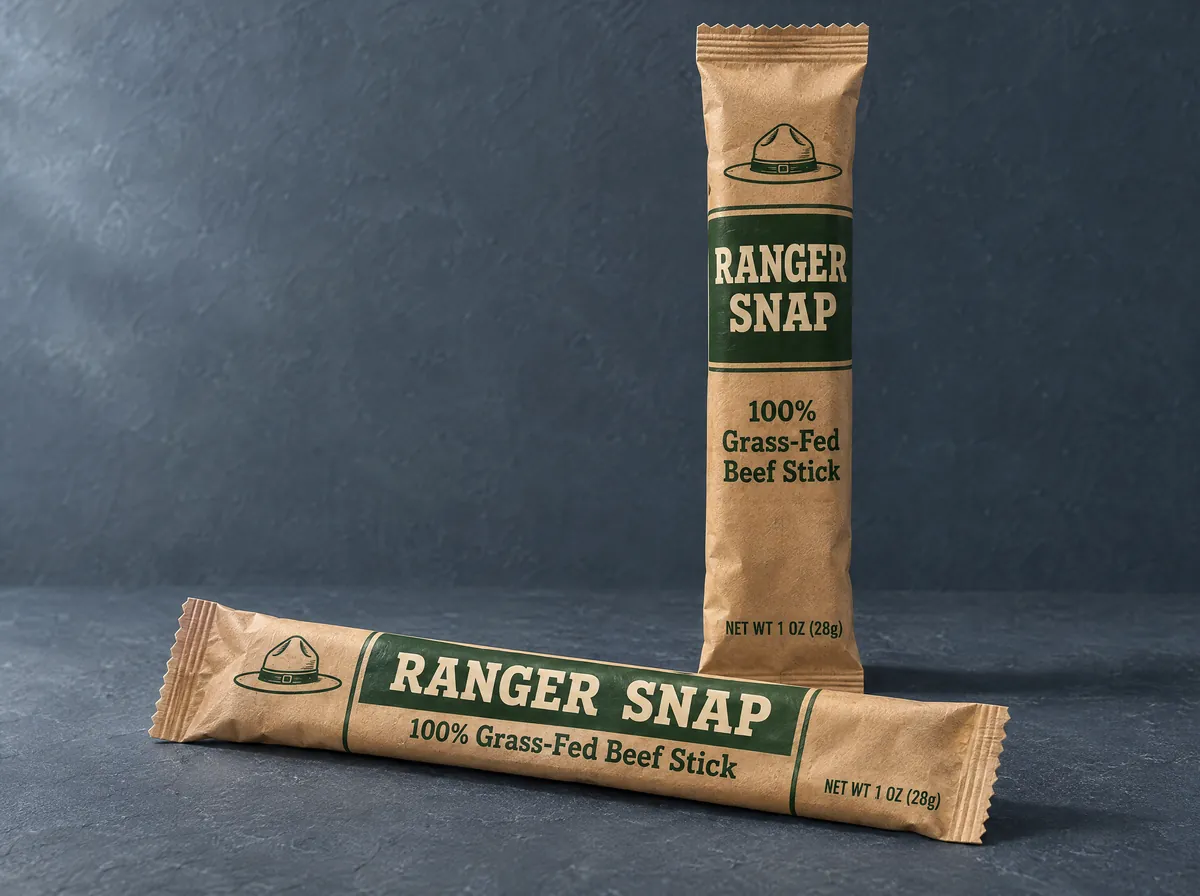
What the founder came for: Expand distribution
The short answer
Ranger Snap's main difficulty is unit economics. At $2.19 a stick, routed through a distributor, the steady-state net retail margin in conventional retail at a 35% retailer margin ranges from -19% to 4%, so it is negative at the low end and only slightly positive at the top. Your primary target, club, cannot buy the product as it is configured today. The product itself is credible. It sits in a fast-growing segment, it is priced in the middle of its shelf rather than at a stretch, and it already has regional distribution and a co-packer behind it.
What this is. A complete CPG Canary report, exactly as the product wrote it.
- Ranger Snap is an invented brand, made to show the product. Its costs, stage and founder are made up, and its own figures appear as they were entered.
- The competitors named, and any price shown for one, come from live web research on the day of the run. Each price carries a link to where it was found.
- Shelf position is a percentile worked out from licensed grocery channel data.
- Margins and unit economics are computed in code, not written by the AI.
$2.19 target price · Growing brand ($500K-$5M annual revenue) · 5,091 words
Key insights
Cutting costs alone will not close the gap at $2.19.: The cost figures below rest on estimated COGS of $0.85-$1.16/unit, a category benchmark; your actual COGS may differ. On that basis, the steady-state net margin in conventional retail at a 35% retailer margin, sold through a distributor, models at -$0.41 to $0.08/unit (-18.9%-3.6%). Every store channel in the model sits below zero at steady state, and only direct-to-consumer is above it. Taking 15% out of COGS lifts the midpoint to -$0.01/unit (-0.5%), which is still short of zero. Raising price 15% gets it to zero. Closing the gap therefore takes three levers together: your real COGS, a route that shrinks the distributor layer (the benchmark distributor margin takes $0.28 to $0.43 per unit before you are paid), and price. The first step costs nothing: replace the benchmark with your co-packer's invoice.
Club, your primary target, has no item it can buy yet.: Clubs stock multipacks, so the sellable unit has to be a 24-count box of your wrapped sticks. The evidence gives three different estimates of where that per-stick price must land: about $1.67 per stick in a $39.99 box, $1.50-1.80, and $1.00-$1.25. All three sit well below your $2.19 single, while the $2.19 retail margin is already underwater. Costco has launched Kirkland grass-fed beef sticks. Member's Mark grass-fed sticks are reported at about $1.00/stick, though that comes from a single source. The likely core buyer is a family pantry-loader who judges value per stick inside a multipack. That is a hypothesis, and it points the same way as the format evidence.
Your front-panel nitrite claim needs rewording.: USDA-FSIS treats celery-cured product as "Uncured." It requires the qualifier "No Nitrates or Nitrites Added except for those naturally occurring in cultured celery powder." An unqualified "no nitrates or nitrites" is a common reason labels are rejected and a common class-action target. FSIS issued celery-curing claim guidance in December 2025, which adds scrutiny. Your buyers read ingredient decks, so a claim they can catch out costs more credibility with them than with most shoppers.
Grass-fed and clean-label no longer set you apart, and the snap is under threat from your own cost-down.: An Archer executive says grass-fed sourcing has become less distinctive. Archer Jerky's stick already uses cultured celery and cherry powders with zero sugar. PepsiCo's Good Warrior claims no nitrates or nitrites. Mission Meats markets a snappy texture. The snap is the one difference left, and natural casing is likely one of your larger cost lines. A casing change made to save money could remove the reason anyone switches.
Sections in this report
- Economic Environment
- Historical Pattern Check (no close match)
- Risk Flags
- Competitive Landscape and Shelf Position
- Regulatory Flags
- Supply Chain Feasibility Flags
- Channel Strategy
- Sensitivity Analysis
- Milestone Roadmap
- Critical Questions
- Narrow Path (If Proceeding Despite Risks)
- Strategic Direction
- Sources cited in this report
Ranger Snap's main difficulty is unit economics. At $2.19 a stick, routed through a distributor, the steady-state net retail margin in conventional retail at a 35% retailer margin ranges from -19% to 4%, so it is negative at the low end and only slightly positive at the top. Your primary target, club, cannot buy the product as it is configured today. The product itself is credible. It sits in a fast-growing segment, it is priced in the middle of its shelf rather than at a stretch, and it already has regional distribution and a co-packer behind it. Its natural-casing snap is a difference a shopper can physically feel, which most clean-label claims are not. The work ahead is to make the stick pay for itself before adding doors, because each new door at today's modeled economics adds loss.
Economic Environment
Food inflation looks moderate at the headline level: food-at-home is running at +3.1%. That figure is misleading for this product. USDA forecasts US beef and veal retail prices up 10.1% in 2026 on a contracting cattle herd, roughly three times grocery inflation. Grass-fed supply is tighter still, and its increase is estimated to be at or above that figure. Ranger Snap is 100% beef with no filler, so there is nothing to dilute the increase. The COGS +15% row in the sensitivity analysis is close to where your input costs are already heading. Global meat prices were almost unchanged year over year, which makes the pressure US-specific. If you import beef to cut cost, tariff exposure is moderate and unverified until your supplier confirms origin.
These headwinds compound. Beef cost rises at the same moment that private label has gained US food and drink share four years running, and private label in all-other dried meat snacks grew +89.3% in dollar sales over the latest 52 weeks (single source). In club, the buyer you most want, store-brand grass-fed sticks are already on shelf. NIQ describes a "barbell" market in which spending concentrates at the value end and at a differentiated premium end, while the middle gets squeezed. Your 52nd-percentile shelf price puts you near that middle on price, while your label puts you at the premium end. Only the snap holds you on the premium side, so it has to come through on every stick. Consumer confidence is mixed: a softer job market, wage growth that lags, and grocery budgets losing share to gas. That argues for a protein-per-dollar value story rather than an indulgence story. The window narrows over time. Beef pressure may build further into spring 2027 if fertilizer costs lift forage costs, though that link is speculative.
Trade spend for jerky and meat snacks runs 18-25% of wholesale shipments, with the natural channel typically 5-10 points lower. In the modeled conventional waterfall, trade takes -$0.20 to -$0.25 per unit out of brand revenue. The modeled trade rates are 16.5% at Whole Foods, 18.5% at Sprouts and 21.5% at Kroger. At $2.19, the price leaves no room for that support in any declared store channel: trade spend is part of why every store row lands below zero. Promotions in club demos or grocery TPRs would deepen a loss that already exists rather than buy growth.
Historical Pattern Check (no close match)
The case library holds no close historical match for this product, so the risk reasoning below rests on the cost, competitive, regulatory and format evidence.
Risk Flags
Price premium: Per ounce, your price is 1.1% above the median of the competitors you named, which is competitively priced. That parity matters because the premium has to be earned elsewhere. Against an estimated store-brand price of $1.78, your $2.19 carries a 23.0% premium. The store-brand threat is moderate, and a gap that size needs a visible reason. The snap is the only candidate, and a shopper cannot see it through a wrapper.
Positioning: Every front-of-pack claim overlaps Chomps: grass-fed, zero sugar, clean label, stick format. Chomps already holds club, grocery and natural distribution, and Forbes estimated its 2025 revenue at about $660M. "Another clean meat stick, with a texture claim" is the read today. The snap has to become the headline, with clean-label as the minimum standard behind it.
Timing: The category is growing. Grass-fed meat-snack volume rose +81% in 2025, corroborated by two sources, and meat sticks were up +16.1%. The declining signal, conventional sticks down -3%, hits soft conventional sticks rather than you. The timing risk is crowding. PepsiCo launched Good Warrior in March 2026, General Mills put EPIC grass-fed sticks into Sprouts, and Jack Link's announced grass-fed multipacks. You are scaling into a lane that well-funded entrants have just joined.
Evidence: The plan rests on several unproven inputs. COGS is a benchmark. Snap durability across shelf life and production runs is untested. No velocity data from your current accounts is in this analysis, and that is the first number any club buyer or distributor will ask for.
Format: A single wrapped stick conflicts directly with club, your primary channel, which sells only multipacks. Club pricing also has to deliver 20%+ per-stick savings against your single. The single stick fits natural caddies and grocery checkout well. Club needs a second configuration with its own economics.
Competitor status: None of your named competitors is discontinued. Paleovalley, The New Primal, Greenridge, Righteous Felon and Archer Jerky could not be confirmed active from the checks run. Chomps, Country Archer, Vermont Smoke & Cure, Good Warrior and Mission Meats are confirmed active.
Competitive Landscape and Shelf Position
Source: Licensed Grocery Channel Data
Format match check: You sell a single 1 oz wrapped stick. Your 1-pack at $2.19 ($2.19/unit) sits at the 52nd percentile of 24 comparable products in the 0.5-2 oz window, ranked on per-package shelf price. That is the middle of the category, and the comparison is reliable. Against branded products only, you sit at the 48th percentile. The panel covers conventional grocery, so natural-only brands may be missing from it.
Like-for-like pricing (single sticks): Your $2.190/oz sits 1.1% above the $2.165/oz median of your named set. That set ranges from $1.790 to $2.990/oz: - the $1.99 Country Archer price you gave (Target) - the $2.29 New Primal price you gave (Sprouts) - the $2.49 Chomps price you gave (Whole Foods) - the $2.99 Paleovalley price you gave (Sprouts)
Separately sourced single-stick prices: - Archer Jerky Classic Beef Stick: $2.29 at Target (source) - Good Warrior Original Beef Stick: $2.69 at Target, confirmed by two sources (1, 2) - Mission Meats: $2.08 at Target (source)
Prices for Righteous Felon and Greenridge single sticks are not shown. Some sources disagree with the prices you gave, at different retailers. Market research lists Chomps Original at $2.69 per 1.15 oz at Target (source) against your $2.49 at Whole Foods. It lists Archer Original at $2.19 per 1 oz at Target (source) against your $1.99. Vermont Smoke & Cure, at the $1.79 you gave, carries no grass-fed claim. Treat it as the conventional default rather than a like-for-like peer.
Tiers: At the value end, Target's store brand Good & Gather sells a grass-fed 1 oz stick at $1.99 (source). The branded premium band runs $2.19-$2.69/oz (Archer, Chomps, Greenridge). Your price sits at the bottom of that band. You are priced like a premium brand without a premium brand's recognition, which leaves the price to be justified by the product.
Key threats: - Chomps has scale, club presence, and a stick that is larger by 0.15 oz. Club shoppers will compare per ounce. - Archer reported $200M revenue in 2024. It already uses your cure system and is shipping 8-count multipacks to Target. - Good Warrior carries PepsiCo distribution and marketing weight behind an identical claim set. - Store brands: Kirkland, Member's Mark and BJ's Wellsley Farms sit in your club targets, and Kroger's Simple Truth Protein line launched with 80+ SKUs.
The jerky subcategory is a sizeable annual market, but the cited source (Snack Food & Wholesale Bakery, State of the Industry 2026) does not state a geography, so its size cannot be tied to a specific market here. The leaders are taking share fast: Chomps gained 822 basis points while Jack Link's lost 573.
White space: No competitor in the set leads with texture as the headline. Mission Meats mentions it in passing. That is the open territory, and it is open only if you own it before someone with a bigger budget does.
Regulatory Flags
No banned or restricted ingredient and no state ban was found. The real items are label and process issues, in priority order:
-
Nitrite claim qualifier. This item is covered under Key Insights. The detail that adds to it: FSIS guidance states that celery powder, including powder used with a nitrate-reducing culture, is not approved as a curing agent under 9 CFR 424.21(c), and describes its permitted uses as flavoring or antimicrobial. The wording you use to describe "curing" on the pack and in marketing therefore matters as much as the front-panel qualifier. Confirm the exact statement with your FSIS label reviewer before printing club cartons.
-
USDA-FSIS jurisdiction. Meat sticks fall under USDA-FSIS, not FDA. Every label requires FSIS pre-approval before production, and the plant must hold a USDA grant of inspection. A new 24-count club carton is a new label. It needs approval, so build that time into any club timeline.
-
"No added sugar." The defined terms are strict: "no added sugars" means no sugar-containing ingredients added during processing. Cherry powder is a fruit ingredient, so confirm with your reviewer that it does not complicate the claim.
-
"Natural" and "clean label." "Clean label" has no regulatory definition. If any "natural" wording appears, USDA requires a brief explanatory statement on pack (for example, "no artificial ingredients, minimally processed"). "Natural" remains the most litigated food claim. Before use, check "no fillers" against FSIS standards of identity for sausage-type products.
-
Allergens and ingredient checks. No Top-9 allergen was detected in the ingredient text available. That text may be incomplete, so supply the full ingredient statement before any "Contains" line is set. Only two of seven ingredients were checked live: cultured celery powder and cherry powder. Neither showed a ban, though neither has a confirmed direct-use GRAS basis. Encapsulated citric acid also appeared in the checks and is GRAS under 21 CFR 184.1033; confirm whether it is in your formula. The remaining ingredients were not searched and should not be treated as cleared.
-
Recall exposure. In 2025, FSIS recalled about 29,541 pounds of Chomps Original Beef Stick over possible metal contamination, and Springville jerky and sticks over undeclared anchovy. Club buyers will ask about your foreign-material controls and your recall plan.
Health and structure/function claim rules apply only if you add health-benefit claims beyond protein content. California Prop 65 exposure was not assessed for this formulation.
Supply Chain Feasibility Flags
Co-packer capacity for the club run. You already have a co-packer. The question is whether it can produce a club configuration at a cost that closes. The supplier research found one strong-fit alternative with public evidence of individually wrapped 0.5-3 oz sticks, USDA inspection and SQF certification: Western Smokehouse Partners (source). Its MOQs and lead times are not published. Quote two or three plants against your current contract. Run length is one of the few cost levers that does not touch the casing. Printed wrapper minimums for flow-wrap typically run 10,000-25,000 units, so a second SKU or carton design ties up cash in film.
Certification. Costco requires a current GFSI-benchmarked certification (BRCGS Grade B+, SQF 85%+, FSSC 22000 or IFS) plus its own Addendum audit, which is often unannounced. Confirm that your co-packer's plant holds one of these for your specific SKU.
Shelf life. The combination of clean-label curing and a natural casing that must keep its snap puts pressure on oxygen barrier and on the remaining shelf life at delivery. Club buyers want generous remaining life on receipt. No validated shelf-life figure for your process exists in this analysis. Get one, measured on the snap as well as on safety, before quoting a club buyer.
Beef sourcing. Imported grass-fed beef is a possible cost lever, but it brings tariff risk, origin-labeling requirements, and a question about whether imported beef fits your brand story. Forward contracts on beef ahead of a club commitment matter more than usual given the 10.1% beef forecast.
Logistics. The product is shelf-stable with no cold chain, which is a real advantage for club distribution centers. Club still means full-truckload palletized delivery and strict in-stock compliance, which carries freight and working-capital weight for a brand of your size.
Channel Strategy
Your primary target is club, so the club economics come first, and the club economics have not been modeled. Pricing a club box against single-unit costs would mix two pack bases. The only surviving figure is a steady-state -18.5% per equivalent unit inside a club multipack. That is not a club item margin, and it should not be compared against the other channels. Give the club pack configuration and it becomes computable. Costco's retailer margin runs 14.0%-15.0%, well below grocery, and Costco charges no traditional slotting. Those are the reasons club can work. The per-stick price compression is the reason it may not.
The other declared channels model below zero at your price: Whole Foods steady-state -$0.22 (-10.0%), Sprouts -$0.23 (-10.3%), Kroger -$0.37 (-19.4%). Year-1 figures are worse: the Year-1 Whole Foods margin is -$1.14 (-52.1%), Sprouts -$1.38 (-62.8%), and Kroger -$2.78 (-146.2%). Every store row carries the benchmark distributor margin. A chain you serve direct would not carry that line, which is why route-to-market is part of your cost answer. Direct-to-consumer models at $0.70/unit (32.0%) steady state.
Regional orientation was not specified, so this ladder assumes you scale outward from your current region. Confirm whether that region should anchor the club and grocery choices below.
-
Start Here (0-6 months): fix the unit, hold the doors. - Get actual COGS from your co-packer. - Price a 24-count club box, and test the natural-casing snap against any cost-down change. - Rewrite the nitrite claim. - Hold or deepen your current regional accounts rather than add new ones, and serve as many as you can direct to strip out the distributor layer. - Use direct-to-consumer as a margin-positive outlet and a source of repeat-purchase data. - Route: direct-to-retail. It fits a bootstrapped balance sheet and is the one route that removes a margin tier.
-
Build Proof (6-12 months): one club region, one natural test. - Approach a single Costco regional division office in your territory. Costco has no portal; you contact the division's food buyers directly. Singing Pastures' expansion into 23 Northeast Costco warehouses shows that regional entry is real. - Alternatively, pitch BJ's, whose buyers use RangeMe and which may accept smaller counts. - In parallel, use Sprouts' Innovation Set: a roughly 90-day trial in a dedicated set, with submission windows that change without notice. Brands hitting velocity there earn continued placement. - For natural distribution, KeHE runs its Summer Show in early February and its Holiday Show in early June. KeHE requires free fill and $5M per-occurrence product liability insurance for meat. - Route: direct to club. For natural, a distributor-led route only after the gate below.
-
Scale (12-24 months): conventional grocery and a second club. - Kroger is a realistic next step at your size, usually with a broker and regional proof. Kroger publishes no review calendar, and practitioners put submission-to-shelf at 6-12 months. - Albertsons/Safeway runs its Innovation Launchpad through RangeMe on a Dec/Jan application window. - Sam's Club comes through Walmart's Open Call. The 2026 window ran July 9-August 3, and it runs annually. - Route: broker-assisted, with a distributor where needed. Broker commissions typically run 5-7%, which the current margin cannot carry.
-
Optimize (24+ months): Rebalance toward whichever of club or natural shows the stronger velocity and margin. Target, at $77,209, is the most expensive modeled launch and belongs at this later stage.
Distributor readiness gate (before any distributor rung): - Modeled per-channel margins above zero after the distributor tier. Today they are all below. - Final case packs, GS1 barcodes, liability insurance and dependable fill rates. - Velocity data from current accounts. - Ideally a retailer purchase order in hand.
Going distributor-first now would add chargebacks and free fill to a stick that already loses money per unit.
Expand inch-wide and mile-deep: concentrate in one metro or region until club or natural velocity is proven, then follow distributor coverage outward.
The Real Cost of Entry
The figures below are modeled ranges, set against your stated $50,000-$250,000 cash.
Club (primary target, a later-stage rung until a club pack exists). - One-time entry: $10,750-$42,500, mostly GFSI certification ($8,000-$25,000) and club-pack corrugate tooling. - Monthly fixed: $92-$950/month. - Float at Net 30-45: not sized, roughly 1.0-1.5 months unpaid. - Exit exposure: $904-$1,809 in orphaned inventory and $276-$5,700 in wind-down. Club runs are large, so an orphaned club run is the single biggest exit risk on this ladder. - Coverage: 7.9-60.0+ months of fixed burn after paying entry. At the low end of your cash range, that is a narrow cushion.
Natural / specialty. - One-time entry: $2,950-$11,000. Organic and Non-GMO verification make up most of it; confirm whether you need either. - Monthly fixed: $442-$2,042/month, largely demos. - Float: $182-$338. - Coverage: 18.9-60.0+ months.
Conventional grocery. - One-time entry: $750-$7,500, plus new-item and broker onboarding, which is unpriced. - Monthly fixed: $192-$1,950/month. - Float at Net 60-90: $2,366-$3,549, rising to $4,732 if one deduction delays payment by a month. - Coverage: 20.0-60.0+ months.
The launch budget model is a complementary view of the same commitment. Its figures ($12,510 for direct-to-consumer, $11,521 for Amazon) overlap with these on working capital and insurance, so do not add the two together. Deduction claims can arrive 6-24 months after shipment. In a documented supplier case, a $140K claim was audited down to $44K, so budget staff time to audit deductions.
The opportunity-cost question is direct. Cash spent on GFSI and corrugate for club is cash not spent on the cost-down work that every channel needs first.
Retail-readiness gates - Before rung 1 expansion: confirm a GS1 prefix and a GTIN for the club carton. Get FSIS approval for the revised label with the nitrite qualifier. Put lot coding, shelf-life dating and a written recall plan in place. - Before the first club rung: GFSI certification at the producing plant. A product liability COI naming the retailer (Walmart, for Sam's, requires $1M per occurrence / $2M aggregate). A finalized 24-count case pack with a Ti-Hi pallet spec. A vendor packet with W-9, banking details and the signed vendor agreement. - Before any distributor rung: the readiness gate above, KeHE's $5M meat-category insurance and hold harmless agreement, and EDI capability.
Sensitivity Analysis
All rows are steady-state net margin in conventional retail at a 35% retailer margin, sold through a distributor. They use midpoint estimated COGS of $1.00/unit and exclude Year-1 slotting. The Current row is the midpoint of the waterfall range above: the same model, not a second estimate.
| Scenario | Price/unit | Est. Margin/unit | Margin % | Margin vs zero |
|---|---|---|---|---|
| -20% | $1.75 | -$0.38 | -21.5% | Below zero |
| -10% | $1.97 | -$0.27 | -13.7% | Below zero |
| Current | $2.19 | -$0.16 | -7.4% | Below zero |
| +10% | $2.41 | -$0.06 | -2.3% | Below zero |
| +15% | $2.52 | -$0.00 | -0.1% | At zero |
| +25% | $2.74 | $0.10 | 3.8% | Above zero |
COGS sensitivity at the current price: - COGS +15% ($1.16/unit): -$0.31/unit (-14.3%) - COGS -15% ($0.85/unit): -$0.01/unit (-0.5%)
Break-even is not reached at current margins.
You are pricing at $2.19. The model reaches zero only at $2.52 and turns positive at $2.74. Both prices would push you above every sourced competitor except Paleovalley, and the market research puts Chomps at the top of the branded band at $2.69. Price alone is therefore not available as a fix. The COGS +15% row is not hypothetical: beef is forecast up 10.1%, and grass-fed likely more. A 15% COGS reduction on its own still leaves the midpoint slightly negative.
For a growing brand, the path combines three moves: - scale-driven COGS reduction through run length, film and freight, with the casing held constant - a direct route that removes some or all of the distributor tier - a modest price move where the snap justifies it
Milestone Roadmap
Phase 1 (0-3 months): Close the Unit
- Replace the benchmark COGS with your co-packer's actual cost. Rerun the waterfall on it.
- Quote two or three USDA-inspected co-packers on run length and wrapper film, with natural casing locked as a fixed specification.
- Run a blind snap test against Chomps and one soft conventional stick, at fresh and at end of shelf life.
- Submit the revised nitrite-qualified label to FSIS. Lock forward beef pricing where your supplier allows it.
Timing: you are already in market, so the dates that matter are the buyer's calendar. Club holiday sets are already locked. The realistic club window is a Q1 2027 New Year's protein rotation, and category resets typically fall in January-February and August-September. Build club inventory only against a purchase order, never against a meeting. A club run with no PO behind it is the largest exit exposure on your ladder.
- Advance when: actual COGS and route put the modeled steady-state margin in at least one declared store channel above zero, and the snap survives the blind test.
Phase 2 (3-6 months): Build the Club Offer
- Spec the 24-count club box. Back-solve landed cost from a per-stick club price inside the estimated ranges. Confirm whether the carton's economics close at that price.
- Confirm GFSI certification at the producing plant.
- Assemble velocity and repeat data from current regional accounts and direct-to-consumer.
- Advance when: the club pack shows a positive margin at a price a club buyer would accept, and your current accounts show velocity you can put in front of a buyer.
Phase 3 (6-12 months): One-Region Proof
- Pitch one Costco regional division or BJ's with samples, the club box, a supply plan and a funded demo budget.
- Enter one natural test, such as Sprouts' Innovation Set.
- Track sell-through weekly. Watch whether demo-driven trial converts to repeat, since the snap is a product that needs trial before it sells.
- Advance when: the club test earns reorders beyond the initial run, and the natural test meets the retailer's velocity bar for continued placement.
Phase 4 (12-24 months): Expand on Proof
- Add Kroger or Albertsons through a broker. Pitch Sam's through the annual Open Call.
- Consider a regional distributor only once the readiness gate is met.
- Advance when: blended margins across live channels stay positive after trade and deductions for two consecutive quarters.
Critical Questions
-
What is your actual landed COGS per stick? If it is at or above the benchmark midpoint, no realistic price closes the retail gap without a structural change to route or run size.
-
Does the snap survive the full shelf life, and every production run, in a blind test? If shoppers cannot tell the difference after a few weeks on shelf, the product has nothing that Chomps, Archer or a store brand lacks.
-
Can a 24-count club box land at a per-stick price a club buyer accepts and still clear a positive margin? If no configuration closes, your primary channel is closed for now.
-
How much of your cost is the natural casing, and can you cut elsewhere first? If closing the margin requires dropping the casing, the brand name stops being true.
-
What is your velocity in current regional accounts today? Without strong local sell-through, a club buyer or distributor has no reason to take the risk on a crowded shelf.
Narrow Path (If Proceeding Despite Risks)
The plan works only if all of these hold:
- Real COGS comes in low enough that, combined with a more direct route, at least one store channel models above zero at a price at or near $2.19.
- The snap is validated and protected. It survives shelf life and production runs in blind testing, and cost cuts come from beef contracts, run length, film and freight rather than the casing.
- A club pack closes on paper before any club conversation. The 24-count box carries its own positive margin at a per-stick price inside club expectations, with GFSI certification in place.
- The label is compliant with the FSIS nitrite qualifier, and the cure story is turned into a transparency asset on pack.
- Expansion stays regional until one club region or one natural test proves repeat purchase. No inventory is built without a PO.
If any one of these fails, adding doors adds loss.
Strategic Direction
Where This Stands
What works: real category momentum, a shelf price that matches the competition, an existing regional base, an existing co-packer, and one tangible sensory difference.
What does not work yet: at your price and estimated costs, every modeled store channel loses money per unit. Your primary channel cannot buy a single stick. Your lead claim needs rewording. Your clean-label profile is now shared by Chomps, Archer, PepsiCo's Good Warrior and store brands.
Rising beef costs make this harder each quarter, so the unit economics have to be fixed before distribution expands. Distribution growth will not fix them.
Pivot Triggers
- If actual COGS, with a direct route, still leaves every store channel below zero, shift spend toward direct-to-consumer and current accounts while you rework the formula or source. Pause new retail.
- If no 24-count club configuration shows a positive margin at a price within club expectations, drop club as the primary target and lead with natural.
- If blind tests show the snap does not survive shelf life or runs, stop pitching texture. Fix the process before any new channel.
- If a regional club or natural test does not earn reorders within one buying cycle, return to the earlier rung rather than adding regions.
- If beef costs move toward the COGS +15% scenario before a club PO is signed, reprice or defer the club launch.
Strategic Path Forward
- Answer the cost question with your real numbers. Get your co-packer's invoice and run-length quotes. Treat the casing as fixed and take the savings from beef contracts, film, freight and run size.
- Own the snap as the brand. "Clean is the minimum; the snap is the point" is open territory, since no competitor leads with texture. Make it demonstrable through sampling, which club and natural both support.
- Build the club item before the club pitch. Price a 24-count box against the per-stick ranges, close its economics, then approach one Costco regional division or BJ's. The Q1 2027 protein window is the timing target.
- Use direct routes to recover the distributor tier. Serving regional accounts direct is one of the few levers that moves the margin without touching price or product.
- Test a second likely buyer cheaply. People eating less because of appetite-suppressing medication may value a small, sugar-free, protein-dense portion. That is a hypothesis to test in direct-to-consumer messaging before any spend.
Your narrowest viable path is a validated snap, a club pack whose economics close, and a direct regional route, in that order. Let's talk through execution.
Questions to Shape Your Plan
- What does your co-packer charge per stick today, and what share of that is casing versus beef?
- Which region are your current accounts in, and which Costco division or BJ's footprint overlaps it?
- Do you sell to your current retailers direct or through a distributor today, and at what price?
Sources cited in this report
Every outside link in the report above, 8 in all, so you can check a figure before you repeat it.
- target.comp/archer-jerky-jalapeno-beef-stick-1oz/-/A-94264169
- 1target.com
- 2gerbes.com
- target.comb/mission-meats/-/N-q643lexpfhx
- target.comp/chomps-original-beef-1-15oz/-/A-85832624
- target.comp/country-archer-original-beef-stick-1oz/-/A-81212277
- target.comp/original-beef-meat-stick-1oz-good-38-gather-8482/-/A-94859160
- wspartners.compartner-with-us/packaging
More sample reports
- Tidepool Yuzu Sparkling Energy Water, a fictional yuzu sparkling energy water
- Nonna Fiora Wood-Fired Margherita Pizza, a fictional wood-fired frozen margherita pizza
- Night Watch Vanilla Oat Cold Brew, a fictional vanilla oat cold brew