
Sample reports / Frozen pizza
Nonna Fiora Wood-Fired Margherita Pizza: the full analysis
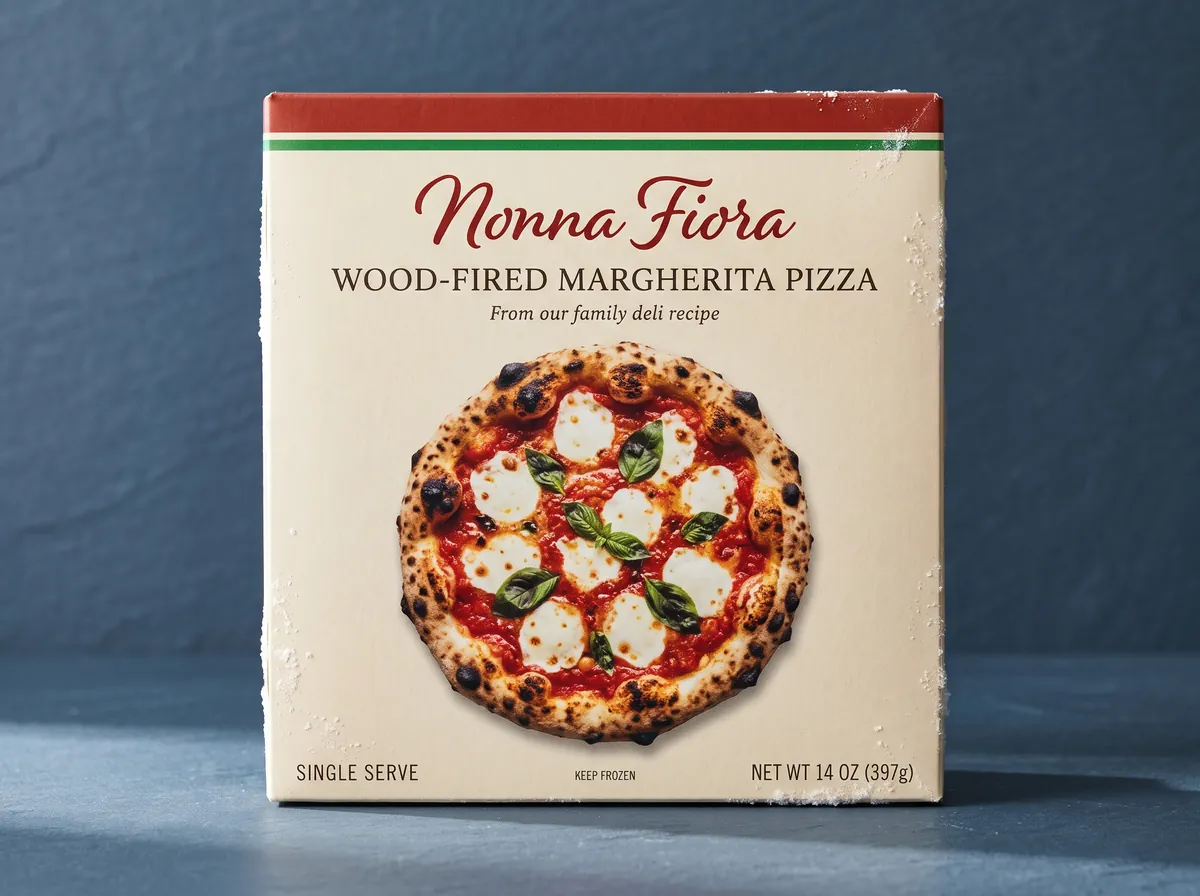
The product, as the founder described it: A single-serve frozen Margherita pizza made from the founder's grandmother's deli recipe — San Marzano tomatoes, fresh mozzarella, and 00 flour — positioned as a real-ingredient, pizzeria-quality alternative to commodity frozen pizza.
What the founder came for: Expand distribution
The short answer
Nonna Fiora's difficulty sits in two places at once: the channel economics and the shelf story. At $8.99 the pizza already ranks among the most expensive frozen pizzas on the shelf. Yet the modeled per-unit margin in Whole Foods and Sprouts lands at or just below zero. That leaves nothing to fund the demos and promotions that usually hold velocity at a premium price. Several things are credible. You own your production. The ingredient list is short and real. You have a Northeast retail base to build proof from.
Cash on hand: $300,000, as the founder stated it.
What this is. A complete CPG Canary report, exactly as the product wrote it.
- Nonna Fiora is an invented brand, made to show the product. Its costs, stage and founder are made up, and its own figures appear as they were entered.
- The competitors named, and any price shown for one, come from live web research on the day of the run. Each price carries a link to where it was found.
- Shelf position is a percentile worked out from licensed grocery channel data.
- Margins and unit economics are computed in code, not written by the AI.
$8.99 target price · Growing brand ($500K-$5M annual revenue) · 4,733 words
Key insights
The natural channel you are targeting first loses money per unit at $8.99 as modeled.: These figures rest on estimated COGS of $2.43 - $3.78/unit, a category benchmark for frozen meals; your actual COGS may differ, and supplying it is the most useful single input you can give. On that basis, after retailer margin, a benchmark distributor margin, trade and deductions: - The steady-state Whole Foods margin at your price models at -$0.01/unit (-0.1%). Sprouts models at -$0.05/unit (-0.6%). - Year 1, with slotting and free fill, models at -$1.13 (-12.6%) for Whole Foods and -$1.78 (-19.8%) for Sprouts. - The Whole Foods row assumes a 35% retailer margin. The published Whole Foods margin in the retailer intel is 40.0%+, so the modeled row is, if anything, generous.
On your shelf-entry challenge: a buyer can say yes and every new door still costs you money. On velocity: no margin remains to fund the promotion that props it up. The per-unit economics come before new doors.
Two parts of the product story do not hold together yet.: First, a grandmother's deli recipe is presented as a wood-fired Neapolitan Margherita. Buyers will notice the mismatch. "Wood-fired" must also be literally true, meaning the crust is baked or par-baked in a wood-fired oven, or it is a claim liability.
Second, the product is described as single-serve, but the size you entered is 14 oz. The personal Margheritas in the evidence are 5.25-5.4 oz. 14 oz matches Blackbird's full Margherita and sits near Pizza Antica's 14.8 oz. Confirm the net weight before any pitch, because it changes who you are compared against and whether the shelf ranking below used the right size class.
At this price the box has to sell the premium by itself, and the ingredient callouts are copyable.: In a glass-door freezer shoppers decide in seconds. San Marzano, 00 flour and fresh mozzarella are the most common premium Margherita claims; Newman's Own already promotes San Marzano on its stone-fired Margherita. Store-brand pressure is moderate: the estimated 365 by Whole Foods price is $7.34, leaving you at a 22.5% premium.
The likely core buyer is a solo urban professional who weighs this against a delivered pizzeria pie rather than other frozen pizzas, and who is unlikely to forgive a disappointing first bake. That is a hypothesis. In-store demos in your current accounts would test it.
The conventional chains you named do not line up with your Northeast base.: The Kroger banners in the evidence are in Cincinnati, Charlotte, Los Angeles, Portland and Denver. The evidence shows no Northeast footprint for Safeway or Publix. The Northeast conventional chains the evidence does cover are different ones, and they are addressed under Channel Strategy.
Frozen pizza is shrinking, and restaurant-quality frozen is the part that grows.: Circana measured US frozen pizza dollar sales down 1.9% and units down 2% in the 52 weeks ended September 6, 2026. Takeout-style and restaurant-quality frozen meals are sized at $14.3B, a signal confirmed by two independent sources. Growth for you means taking share from pizzerias and premium pies, so the home-oven bake has to prove "pizzeria-quality" on the first try.
Sections in this report
- Economic Environment
- Historical Pattern Check (no close match)
- Risk Flags
- Competitive Landscape and Shelf Position
- Regulatory Flags
- Supply Chain Feasibility Flags
- Channel Strategy
- Sensitivity Analysis
- Milestone Roadmap
- Critical Questions
- Narrow Path (If Proceeding Despite Risks)
- Strategic Direction
- Sources cited in this report
Nonna Fiora's difficulty sits in two places at once: the channel economics and the shelf story. At $8.99 the pizza already ranks among the most expensive frozen pizzas on the shelf. Yet the modeled per-unit margin in Whole Foods and Sprouts lands at or just below zero. That leaves nothing to fund the demos and promotions that usually hold velocity at a premium price. Several things are credible. You own your production. The ingredient list is short and real. You have a Northeast retail base to build proof from. And pizzeria and delivery prices are rising faster than grocery prices, so a believable pizzeria-at-home pie is worth more today than a year ago. Expansion works only if price, cost or the route to shelf moves the natural-channel margin above zero, and the box explains the premium at a glance.
Economic Environment
Headline inflation points the wrong way for this product. No frozen-pizza CPI line exists. The closest proxy, US food-at-home inflation, ran 2.7% YoY (USDA, May 2026) against 3.1% for all food. The estimate for frozen pizza specifically is roughly 3-5%, because tomato products, cheese and freight carry outsized weight. The Northeast food-at-home index was flat over 90 days (+0.0%), so regional grocery prices are not rising in a way that would make room for you to raise yours.
Meanwhile your real competitor, the pizzeria, is inflating faster. Food-away-from-home ran 3.5% in May and 3.7% in September, and full-service meals 4.2%. That widens the value gap in your favor if the pizzeria claim is believable.
The headwinds compound: - Tomatoes, your hero input, rose more than any other US food in 2026 (NACS). The roughly 17% tariff on Mexican tomatoes hits fresh Mexican product, not Italian San Marzano. Still, the tight tomato market weakens your leverage with importers. - 2027 contracts. Fertilizer disruption from the Gulf points to an estimated +3-8% on tomato product and flour inputs at 2027 renewals (indicative, Italy-grown supply). These contracts are being set now, Q4 2026 to Q1 2027. - Freight. Fuel surcharges add an estimated +1-3% to landed and delivered cost per case over the next 3-6 months, on inbound Italian inputs and on outbound frozen distribution. - Shoppers. Store brands are expected to outpace national brands in 2026. Low confidence "will hit more expensive brands the most."
Together: costs rising, a shelf-price ceiling that is not moving, and shoppers splitting between private label and a narrower affluent tier. The window for a premium single SKU narrows as 2027 contracts reset.
The offsets are real but specific. Northeast-only lanes are short. Q4 to Q1 is peak frozen pizza season in cold-weather markets, through the Super Bowl in February 2027. Natural-channel Northeast shoppers are somewhat more insulated from the confidence slump.
Trade spend. The category benchmark is 25-35% of wholesale shipments for frozen meals, with the natural channel typically 5-10 points lower. The steady-state waterfall carries trade of $1.26 to $1.54 per unit, and the channel rows apply 25.0% for Whole Foods and 27.0% for Sprouts. The natural-channel margins above already include that trade. Any promotion beyond benchmark, such as the 2-for-$15 type of deal the economic analysis expects you will need to sustain velocity, comes straight out of a margin already at or below zero. At $8.99 the price leaves no room for extra trade support in either declared channel.
Historical Pattern Check (no close match)
The case library holds no close historical match for this product, so the risks here are built from the cost, shelf, competitor and retailer evidence.
Risk Flags
- Price premium: Against your own competitor set you are 5.9% above the competitor median of $8.49/unit. That set mixes formats, though. Screamin' Sicilian and Motor City are pan pizzas with sizes not supplied. Against the licensed panel you sit at the 98th percentile. The premium is earned only if the shopper can see the difference on the box. Today the brand reads as quality ingredients from a family recipe, which describes attributes rather than giving a reason to choose it.
- Positioning: The deli-versus-wood-fired origin conflict, plus a heritage angle shared with many Italian-heritage brands, leaves the product's most distinctive feature unused: a real pizzeria pie sized for one person, eaten tonight.
- Timing: Frozen pizza overall is declining (Circana, above). What is rising, and confirmed across sources:
- restaurant-quality frozen meals;
- clean-ingredient premium convenience, including Mintel data that 43% cite premium ingredients.
Your spec sits on both. Protein-forward frozen meals are also rising and corroborated, and Nonna Fiora makes no protein claim; CAULIPOWER already sells a 21 g protein single-serve Margherita. Conagra's exit from Celeste is a brand exit, not evidence that personal pizzas are declining. One early Northeast signal is worth watching: Silver Sands' restaurant-recipe frozen pizzas at select Big Y and Adams Hometown Market stores. If it holds, regional pizzeria provenance is a lane you can occupy. - Evidence: The plan rests on three unproven points: velocity at existing accounts (not provided), actual COGS (not provided), and whether the crust stays crisp under fresh mozzarella in a home oven. - Competitor status: One of the competitors you named, Amy's, appears on a closure headline: "Beloved Amy's Kitchen Venture Is Officially Going Out of Business" (VegNews). The same evidence shows Amy's launching a personal Margherita at Target in October 2025 and landing Costco distribution in May 2026. The closure refers to a venture, not the frozen line. Confirm on a retailer site; do not treat the segment as dead. - Format: The single box is the most expensive option in the freezer door. If it does not read as pizzeria quality in seconds, trial stalls. A one-SKU Margherita also gives buyers little reason to grant an expensive freezer facing. Expect requests for a three-SKU line.
Competitive Landscape and Shelf Position
Source: Licensed Grocery Channel Data
Format match check. Your 1-pack at $8.99 ($8.99/unit) is a single 14 oz boxed frozen Margherita. Like-for-like comparisons below use frozen Margheritas of similar weight. Personal-size pies and pan pizzas are treated separately.
Panel position. Against 61 comparable products in the 10-20 oz class, on per-package shelf price, Nonna Fiora sits at the 98th percentile (high confidence). Against branded products only, it is also the 98th percentile, out of 58. Three caveats apply: - The ranking is not per ounce. - The panel covers conventional grocery, so natural-store pies like pi00a may be missing. Your position is likely less extreme in the natural set. - The typical mainstream frozen pizza range of $5-10 makes the ranking plausible: you sit inside that range but at its top.
Direct peers, similar size: - Blackbird Frozen Margherita, 14 oz: $8.99 at Target (source). Same price and size, but plant-based cheese. Carried at Target, Whole Foods and Sprouts. - pi00a Margherita, 10.5 oz: $12.99, confirmed by two sources (1, 2). Uses 00 flour, Italian tomatoes and mozzarella, your exact story at a higher price. Small, at nearly 40 Whole Foods stores. - Pizza Antica Margherita, 14.8 oz: $11.49–$16.99. The two sources differ: $11.49 at Target (1) and $16.99 at Andronico's (2). Bay Area footprint. - Newman's Own Stone-Fired Margherita, 13.1 oz: price not shown. It is named at Stop & Shop, Giant and Hannaford, your home region's conventional chains, and it already promotes San Marzano.
Against true size peers, $8.99 sits at or below the artisan pies. That supports the price if the pizza really is 14 oz.
Personal-size pies (different format). Amy's personal Margherita is $6.29 for 5.25 oz at Target (source). CAULIPOWER is $5.99 for 5.4 oz (source). If your box says "single-serve," these become the shopper's comparison, and $8.99 looks steep.
Incumbents. Screamin' Sicilian ($7.99, your figure) is national and sold "in almost every retailer." Table 87 is $10.99 at King Soopers (source), is at Whole Foods, sells mainly east of the Mississippi, and has revenue reported around $5M. It is the closest model of a regional premium pie with a specific place story. Motor City ($8.99, your figure) is Detroit-style and a different product.
Store brand. The scan covered Whole Foods, Kroger and Albertsons/Safeway. Sprouts and Publix were not covered, so store-brand exposure there is not assessed. The open question for buyers is why Whole Foods should carry a $8.99 pie when 365 could launch near the estimated $7.34 and keep the full margin.
Price versus cost. The cost evidence gives no single required price. Under the conventional-retail model, $8.99 sits just above the modeled zero line. In Whole Foods and Sprouts at your price, the rows already sit just below it. The premium is therefore mostly forced by the cost structure of frozen distribution and retailer margins rather than chosen as a cushion. It becomes earned only when the shelf communicates a difference shoppers will pay for.
Regulatory Flags
No banned ingredient or state restriction was found. FDA is the primary regulator, since the recipe contains no meat, so USDA jurisdiction does not apply. The live issues, in priority order:
- Allergen declaration. The statement derived from your ingredient list is "Contains: Wheat". That derivation picked up only the flour. Fresh mozzarella is a dairy cheese, so check your printed label against the milk declaration requirement before any new retailer reviews it. Frozen pizza is exposed on sub-ingredients. In 2026 Saint Francis Apizza recalled frozen pizzas, including plain cheese, over undeclared soy from sub-ingredients (FDA). Every component's allergens, including the mozzarella culture, any dusting flour and oil blends, must flow to the final label. Sesame is the ninth major allergen; confirm no cross-contact in your own facility.
- Claims that may face scrutiny. - "Wood-fired" must describe how the crust is actually baked. - "San Marzano" implies a specific Italian origin. Hold importer documentation, because natural-channel buyers verify sourcing claims. - "Pizzeria-quality" is puffery, but it sets the sensory bar the home bake must meet.
- Pathogen controls. A 2025 multi-brand Listeria recall of frozen and ready-to-eat prepared meals (FDA) is a reminder that environmental monitoring in your plant will be asked about by distributors.
California Prop 65 does not apply to a Northeast-only footprint. Revisit it only if you ship into California.
Supply Chain Feasibility Flags
You produce in your own facility, so the questions are about capacity and inputs.
- Co-packer backup. The co-packer search returned frozen plated-entrée makers, such as Northern Culinary Brands in Plattsburgh, NY. It returned no pizza producers, so backup capacity for this format is not assessed here.
- Wood-fired throughput. If the "wood-fired" claim is literal, oven capacity sets your ceiling. Expansion into a distributor such as KeHE or UNFI requires dependable fill rates. Know your maximum weekly output and freezer storage at -10°F before committing doors.
- Packaging minimums. Box runs of 10K-30K units can mean many months of inventory at early regional velocity. That locks in artwork and claims at exactly the moment the positioning and possibly the "single-serve" wording should change. Settle positioning and net-weight language before the next box order. The board must be freezer-grade, since uncoated paperboard softens and scuffs and that undermines a premium look.
- Imported inputs. San Marzano tomatoes and 00 flour come in through the US-EU import regime, at rates the sources did not quantify. Confirm duty exposure with your importer. Lock 2027 tomato and flour contracts early, given the renewal pressure described under Economic Environment.
- Shelf life. No validated frozen shelf life is on file. Retailers and distributors will require it, along with lot coding.
Channel Strategy
The cost model lists Whole Foods, Sprouts, DTC, Amazon and convenience as open to you now. Kroger is a next step, usually reached with a broker and regional proof. Your intake says you sell through local or regional retail today, while the cost model assumes a distributor. If you self-deliver now, that is your current route and it avoids the distributor cut in the waterfall. Tell us your actual route; it changes the margins materially.
Because you anchor in the Northeast, the ladder stays in the Northeast.
- Start Here (0-6 months): deepen current Northeast accounts and fix the unit economics. - Mechanism: direct-to-retail, as today. - Run demos in existing stores and capture units per store per week by store. - DTC is the only modeled channel above zero, at a steady-state $3.55/unit (39.5%), with a modeled launch budget of $16,710. Treat it as a margin-positive way to gather repeat-purchase data, and check that the model's shipping line reflects frozen shipping cost. - Apply in parallel to the Whole Foods Local and Emerging Accelerator Program (LEAP). It runs annually; the 2026 window opened June 2 via RangeMe. Watch for the next June window, which is not yet confirmed.
- Build Proof (6-12 months): natural channel, Northeast first. - Whole Foods' route is UNFI. Slotting is published as ?-$25,000/SKU (the low end is not published), with a retailer margin of 40.0%+. Category reviews are annual reset rounds. - Sprouts takes new items year-round through its New Item Submission form. Its Innovation Set resets on roughly 90-day cycles and judges velocity and repeat. Its route is KeHE, free fill is required, and its retailer margin is 33.6%-38.8%. - The Fresh Market reviews through RangeMe only and has no traditional slotting (documented). That is a lower-cost natural/specialty door worth testing. - Mechanism: distributor-led, only after the gate below.
- Scale (12-24 months): Northeast conventional grocery. - The Northeast conventional evidence covers Stop & Shop, Giant Food, Giant/Martin's and Hannaford. One RangeMe profile plus the Ahold Delhaize USA questionnaire covers all five banners. These chains self-distribute, and Newman's Own's stone-fired Margherita is already there. - Kroger, Safeway and Publix sit outside your proven region. The modeled Kroger margin is -$0.69 (-8.9%) at steady state and -$4.07 (-52.1%) in Year 1, with a modeled launch budget of $153,794. - Mechanism: broker-assisted (commission typically 5-7%), once velocity data exists.
- Optimize (24+ months): decide on a second and third SKU and whether conventional grocery earns a permanent role, based on the scale rung's results.
Distributor readiness gate (before KeHE or UNFI). These are thresholds to reach, not judgments: - The modeled Whole Foods and Sprouts margins sit above zero at the price you will actually ship. - Final case packs, GS1 barcodes, and liability insurance at KeHE's stated $2M per occurrence / $2M aggregate with KeHE as additional insured, plus a hold harmless agreement and EDI capability. - Velocity data from current accounts. - Ideally, a retailer commitment in hand. KeHE buys around its February Summer Show and June Holiday Show.
Going distributor-first before this gate risks low velocity, chargebacks and a burned relationship.
Retail-readiness gates. - Before rung 1 expansion: confirm GTINs and barcode print quality; confirm a label with a complete allergen declaration (see Regulatory Flags); confirm a written recall plan and lot coding. - Before the first chain rung: finalize case pack and Ti-Hi pallet spec; obtain a certificate of insurance naming the retailer; complete the vendor packet (W-9, remittance details, signed agreements); establish validated shelf life. - Before any distributor rung: EDI capability, per KeHE.
Break-even scale, for context: covering $15K/month of fixed costs takes 71,428 units/month, or 10,997 doors at an assumed 1.5 units/store/week. That assumption is the category's "acceptable" velocity benchmark, and the door count it produces argues for higher velocity per door rather than more doors.
The Real Cost of Entry
Two views of the same commitment are shown here and should never be added together. The launch budget figures above are the Year-1 all-in launch models per channel. The figures below are the hidden fixed stack for your declared targets. They overlap on working capital and insurance.
Natural/specialty, your primary target (modeled ranges): - One-time entry: $2,950-$11,000. This includes organic and Non-GMO verification; drop those lines if you will not pursue the certifications. - Monthly fixed: $442-$2,042/month, which includes demos. - Float at Net 30-45: $810-$1,494 unpaid, extending to $2,490 after one deduction-delayed month. - Exit exposure: orphaned inventory of $522-$1,630 and wind-down costs of $884-$8,168. - Slotting and free fill sit in the channel rows above, not here.
Conventional grocery (modeled ranges): - One-time entry: $750-$7,500, with new-item paperwork and broker onboarding unpriced. - Monthly fixed: $192-$1,950/month. - Float at Net 60-90: $10,530-$15,795, extending to $21,060. - Exit exposure: orphaned inventory of $5,589-$11,178 and wind-down costs of $576-$11,700.
Three thresholds to examine: 1. Can you afford the game? Yes. On your $300,000, both stacks show 60+ months of coverage. 2. Can you afford the float? In natural, easily. Conventional ties up far more cash at longer terms. 3. What is the opportunity cost? Cash is not the constraint. Every new door at a below-zero margin converts that cash into losses, and capital spent on conventional entry is capital not spent fixing the natural-channel economics.
Deduction claims can arrive 6-24 months after shipment. A documented supplier case saw a $140K claim audited down to $44K, so build deduction auditing in from day one.
Sensitivity Analysis
All rows below come from one model: - steady-state net margin; - conventional retail at a 30% retailer margin, through a benchmark distributor; - estimated midpoint COGS of $3.10 (category benchmark), excluding Year-1 slotting.
The Current row is the midpoint of the steady-state retail range of -$0.91 - $1.35/unit (-10.1-15.0%), the same model rather than a second estimate. The price rows assume a distributor would hold the same share of shelf price, which nobody has confirmed.
| Scenario | Price/unit | Est. Margin/unit | Margin % | Margin vs zero |
|---|---|---|---|---|
| -20% | $7.19 | -$0.73 | -10.1% | Below zero |
| -10% | $8.09 | -$0.26 | -3.2% | Below zero |
| Current | $8.99 | $0.21 | 2.4% | Above zero |
| +10% | $9.89 | $0.69 | 6.9% | Above zero |
| +15% | $10.34 | $0.92 | 8.9% | Above zero |
| +25% | $11.24 | $1.39 | 12.4% | Above zero |
COGS at the current price: - At +15% ($3.57/unit), the margin falls to -$0.25/unit (-2.8%). - At -15% ($2.64/unit), it rises to $0.68/unit (7.6%).
The +15% COGS case is a realistic risk. Tomatoes led US food inflation in 2026, and 2027 tomato and flour contracts carry an estimated +3-8% renewal pressure on top of freight surcharges, which together move you toward it.
Price is the weaker lever here. Northeast grocery prices are flat and you already sit at the panel's top, so the 2027 contract negotiation and your plant's yield matter more. Any discounting moves you into the lower rows, and the -10% row is already below zero. For a growing brand, the question is how much trade you can absorb, and at current figures the answer is none beyond benchmark.
Milestone Roadmap
Phase 1 (0-3 months): Replace estimates with your numbers
- Enter actual COGS per unit and your real route to shelf (self-delivered or distributor). This replaces the benchmark that drives every margin figure above.
- Confirm net weight and settle the size language ("single-serve" or not) and the origin story (deli recipe, wood-fired bake) before the next box run.
- Run a blind home-oven bake test with non-expert cooks, checking crust crispness under fresh mozzarella.
- Lock 2027 tomato and flour contracts before renewal pressure lands.
- Advance when: the recomputed Whole Foods and Sprouts margins sit above zero at your planned price, or you have a specific cost or route change that gets them there.
Phase 2 (3-6 months): Velocity proof in current Northeast accounts
- Run demos and capture weekly units per store by store. Find the stores where the product performs.
- Test the "pizzeria pie for one" front panel against the current box in a subset of stores.
- Launch DTC as a repeat-purchase data source, within the modeled $16,710 budget.
- Advance when: velocity holds at or above the 1.5 units/store/week acceptable benchmark for 8 consecutive weeks. The background material points to more than 5 at a true premium price as the level that defends shelf space. If velocity stays below the benchmark, current accounts are the honest home for now.
Phase 3 (6-12 months): First natural-channel rung
- Submit to Sprouts' Innovation Set and The Fresh Market via RangeMe. Apply to Whole Foods LEAP in its June window.
- Pass the distributor readiness gate before engaging KeHE or UNFI.
- Develop a second and third SKU to answer the single-SKU objection.
- Advance when: one natural chain places the item and its Innovation Set or test-period velocity earns continuation.
Phase 4 (12-24 months): Northeast conventional
- Submit to the Ahold Delhaize banners through one RangeMe profile, with broker support.
- Advance when: natural-channel velocity and margin both hold through a full reset cycle.
Critical Questions
- What are your actual COGS per unit and your actual route to shelf? If COGS sits at or above the benchmark midpoint and you ship through a distributor, the natural channel loses money at $8.99.
- What is units per store per week at existing accounts, and is it rising or falling? Every buyer and distributor asks this first.
- Is the pizza 14 oz, and is the crust actually baked in a wood-fired oven? A wrong answer on either undercuts the pitch and the label.
- Does the crust stay crisp with fresh mozzarella in an ordinary home oven? A disappointing first bake at this price is unlikely to get a second purchase.
- What on the box could a premium store brand not copy? If the answer is only the ingredient list, the shelf position is exposed.
Narrow Path (If Proceeding Despite Risks)
All of these must hold together: - Margins clear zero in the target channels. Actual COGS or a direct route (no distributor cut) must put the Whole Foods and Sprouts margins above zero at your shelf price, with room for benchmark trade. - The story is consistent and true. The origin reconciles deli and wood-fired honestly, and the net weight matches the size claim on the front panel. - The product proves itself in the home oven. A blind bake test shows the crust holds. - Velocity is documented. Data from current Northeast accounts reaches the acceptable benchmark before any distributor conversation. - Expansion stays regional. Natural/specialty in the Northeast comes first. Conventional follows only after a full reset cycle of proof, through chains with Northeast footprints.
Strategic Direction
Where This Stands
What works: you have a real product with a short, readable ingredient list. You own production. You have a Northeast retail base. And the pizzeria-at-home comparison grows stronger as restaurant prices outrun grocery prices.
What does not work yet: - The modeled economics in your primary target channel sit at or below zero per unit, before Year-1 entry costs. - The front of the box tells an ingredient story that peers and store brands already tell. - The origin and size claims conflict.
What has to change: actual cost data and the actual route need to show a positive margin, and the box has to explain in seconds why this pie costs what it costs. Until both hold, more doors mean more losses.
Pivot Triggers
- If recomputed natural-channel margins stay below zero after entering actual COGS and route, rework the cost structure or price before any new chain submission.
- If velocity at existing accounts stays below 1.5 units/store/week for 8 weeks after demos, rebuild the front panel before seeking new doors.
- If the home-oven bake test shows a soggy crust with fresh mozzarella, reformulate before expanding. Do not discount your way through it.
- If 2027 contract renewals push COGS toward the +15% scenario, put cost recovery ahead of distribution growth.
- If a Sprouts Innovation Set or similar trial ends without continuation, stay in current accounts and DTC for another cycle.
Strategic Path Forward
- Reposition around the gap the brand already half-occupies: a real pizzeria pie made for one, eaten tonight. Make the heritage story specific (name the deli, city and year, as Table 87 does with Brooklyn) and move it to the side panel as proof.
- Make DTC the profitable proof engine. It is the only modeled channel above zero at $3.55/unit. Use it for repeat-purchase data, not volume.
- Treat the protein gap as a SKU decision. Protein-forward frozen meals are a corroborated rising signal, and CAULIPOWER's 21 g Margherita shows the move. A second SKU could carry it without diluting the Margherita.
- Test the possible second buyer group in your current conventional accounts. That group is label-reading parents buying a single meal a selective child will eat. It is a hypothesis, cheap to check with a shelf tag.
- Time natural-channel entry to Whole Foods' June LEAP window and KeHE's February and June shows, once the margin and velocity gates are met.
Questions to Shape Your Plan
- Do you self-deliver to your current accounts today, or does a distributor already sit between you and the store?
- How much weekly capacity does your wood-fired oven support, and at what point would you need a second line or a co-packer?
- Is the family office expecting expansion within a set timeframe, or does it support a slower Northeast-only proof cycle?
Sources cited in this report
Every outside link in the report above, 11 in all, so you can check a figure before you repeat it.
- VegNewsvegnews.com
- target.comp/blackbird-frozen-margherita-plant-based-pizza-14oz/-/A-86795417
- 1wholefoodsmarket.com
- 2goodeggs.com
- 1target.com
- 2andronicos.com
- target.comp/amy-39-s-frozen-margherita-personal-size-pizza-5-25-oz/-/A-94685640
- cub.comstore/cub/products/91207446-caulipower-margherita-cauliflower-crust-pi…
- kingsoopers.comq/table+87
- FDAfda.gov
- FDAfda.gov
More sample reports
- Ranger Snap, a fictional grass-fed beef snack stick
- Tidepool Yuzu Sparkling Energy Water, a fictional yuzu sparkling energy water
- Night Watch Vanilla Oat Cold Brew, a fictional vanilla oat cold brew