
Sample reports / Functional beverages
Tidepool Yuzu Sparkling Energy Water: the full analysis
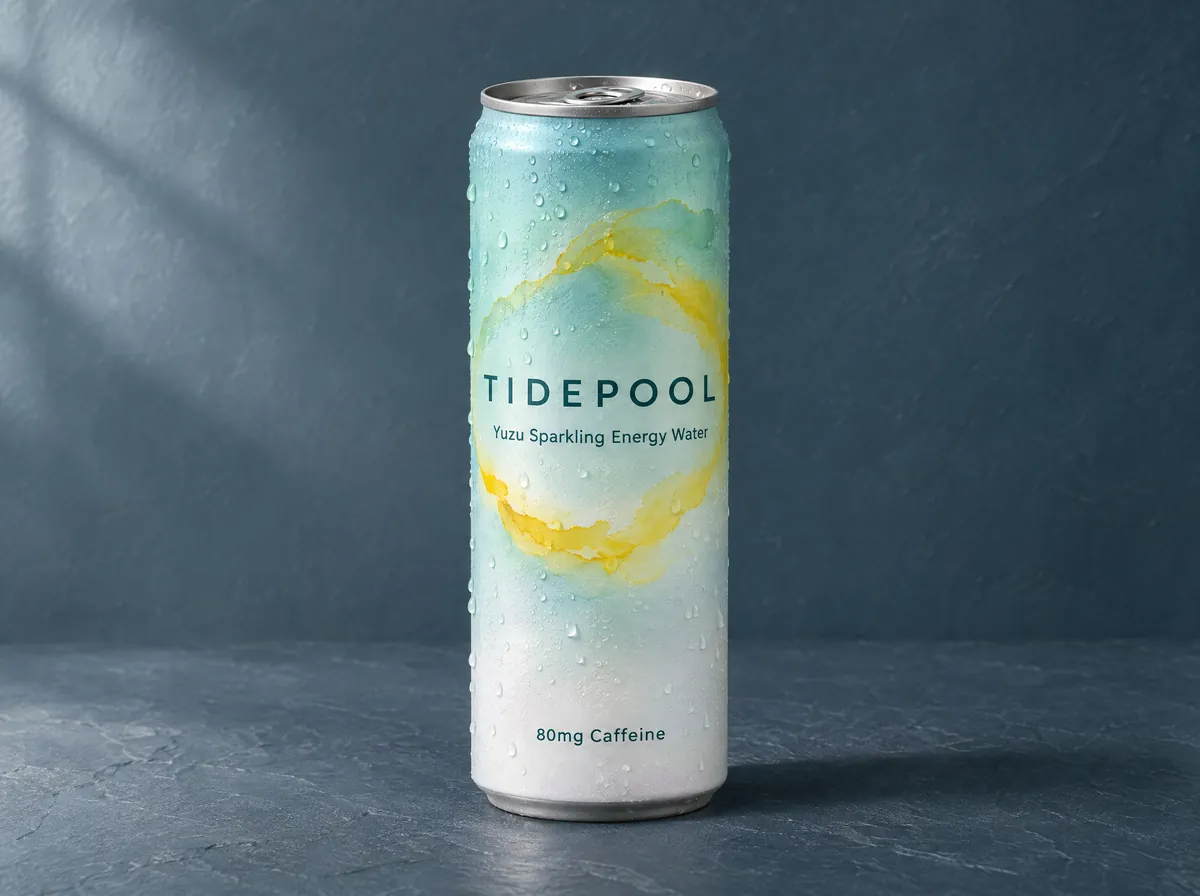
The product, as the founder described it: A sparkling energy water made with real yuzu juice, 80mg caffeine from green coffee bean extract, and monk fruit sweetener — positioned as a clean, crash-free lift for coastal professionals aged 25–40 who want functional energy without the artificiality of con…
What the founder came for: Expand distribution
The short answer
Tidepool's main difficulty is the channel. The c-store cold case you chose as your primary target is where the product's economics, pack format and three-second shelf read are all weakest at the same time, and there is not yet a sell-through number to show a buyer or distributor. Several things are credible. The formula sits in a real gap between lightly caffeinated seltzers and high-dose energy cans. Your $2.99 single can is priced just under the cold-case leader per ounce. The founder story and dry voice suit a buyer who dislikes energy-drink culture.
Cash on hand: $60,000, as the founder stated it.
What this is. A complete CPG Canary report, exactly as the product wrote it.
- Tidepool is an invented brand, made to show the product. Its costs, stage and founder are made up, and its own figures appear as they were entered.
- The competitors named, and any price shown for one, come from live web research on the day of the run. Each price carries a link to where it was found.
- Shelf position is a percentile worked out from licensed grocery channel data.
- Margins and unit economics are computed in code, not written by the AI.
$2.99 target price · Early-stage (<$500K annual revenue) · 4,750 words
Key insights
Expansion has to wait for a velocity number, and a distributor will not fix the margin.: The direct answer to your goal: do not add doors until you know units per store per week in your current accounts and whether the gap is trial or repeat. As captured during intake, you rely on shelf checks and have no POS data.
The economics argue for the same sequence. The figures rest on estimated COGS of $0.62-$0.96/unit, a category benchmark; your actual COGS may differ. On that basis, a c-store sale at your $2.99 routed through a distributor models at a steady-state margin of -$0.12/unit (-4.0%), and the Year-1 c-store margin is -$0.35/unit (-11.5%).
The modeled lean break-even is 31,250 units/month across 2,405 doors, assuming 3.0 units/store/week. The intake-captured instinct that distributor economics may not pencil at a few thousand cans a month matches the model. Today the money sits in accounts you deliver yourself and in DTC.
Confirm the pack before anything else.: At intake you selected an 8-12 count multipack, but the record carries one unit at $2.99. Every figure in this report treats $2.99 as the price of one 12 oz can. If $2.99 was meant as a multipack price, the analysis needs rerunning. C-store energy shelves are built around single cold cans, and multipacks rarely get c-store space. The multipack belongs to DTC and take-home grocery. The single can is the c-store product.
At the shelf, Tidepool currently says what its nearest peer says.: heywell sells a 12 oz sparkling can with 75 mg organic green coffee caffeine at $2.99 at Target (source) and $3.99 at Good Eggs (source); the two sources differ. "Clean, crash-free lift" is category boilerplate, and a BUBBL'R ambassador reports the same no-crash feedback for a 69 mg seltzer.
At the cold case, three things work against you. The origin story is invisible. "Sparkling water" may get filed with seltzers. And 80 mg reads as weak beside high-dose cans unless the can says the lower dose is the point. The shelf also has a recent record: PepsiCo removed three Bubly Bounce caffeinated flavors, and Target discontinued two Good & Gather caffeinated sparkling waters. Retailers are cutting slow SKUs in exactly this sub-segment.
Celsius is still a live competitor.: The only source calling Celsius discontinued is a high-school news site. Celsius Holdings reported Q3 2026 results (source) and reports 99.5% ACV through PepsiCo. Plan against it as an active, scaled rival.
Buyer fit holds on attributes but only partly on channel.: The likely core buyer is a West Coast professional in the stated age range who wants a lift without energy-drink culture, buys single cans on a daily route, and would likely switch from sugar-free Red Bull. Price and formula plausibly fit her. The fit is weaker at highway c-stores than at urban corner stores and natural grocers. This is a hypothesis; a two-account repeat tracker would test it.
Sections in this report
- Economic Environment
- Historical Pattern Check (no close match)
- Risk Flags
- Competitive Landscape and Shelf Position
- Regulatory Flags
- Supply Chain Feasibility Flags
- Channel Strategy
- Sensitivity Analysis
- Milestone Roadmap
- Critical Questions
- Narrow Path (If Proceeding Despite Risks)
- Strategic Direction
- Sources cited in this report
Tidepool's main difficulty is the channel. The c-store cold case you chose as your primary target is where the product's economics, pack format and three-second shelf read are all weakest at the same time, and there is not yet a sell-through number to show a buyer or distributor. Several things are credible. The formula sits in a real gap between lightly caffeinated seltzers and high-dose energy cans. Your $2.99 single can is priced just under the cold-case leader per ounce. The founder story and dry voice suit a buyer who dislikes energy-drink culture. And the brand's regional base, the Pacific Northwest and Northern California, is where that buyer is likely to live. The question is which shelf, which pack and which route let those strengths show up as units.
Economic Environment
Demand conditions are reasonably supportive for this specific buyer. CoBank reports the top 10% of earners increasing spending on novel products, a cohort that overlaps the coastal professional target. Trade-down is real but moderate: 82% of $100K+ households report increasing private-label purchases, and younger shoppers rate store-brand quality at parity.
The sources give no headline CPI and no energy-drink inflation rate. The relevant signal is food-away-from-home inflation at 3.7% in September. Over 90 days, food-away-from-home CPI rose +1.0% against +0.6% for food-at-home. Price pressure is running hottest in the c-store and foodservice channel, which is where your primary channel sits. That is national data, not specific to the Pacific Northwest or Northern California.
The cost side is where conditions stack against you. - Input inflation: estimated at about 3-6%. - Monk fruit: the most tariff-exposed input, estimated at about +5-15% landed cost. It is mostly sourced from China. - Yuzu and green coffee extract: both are imported. Yuzu has no buying leverage at your scale, and green coffee extract cost is volatile. - Cans: packaging tariffs keep costs structurally elevated. - Overall tariff exposure: high, because three of the four functional inputs are import-dependent.
These pressures compound. Costs are rising while sources describe brands as very careful about price increases, so pass-through at $2.99 is blocked. At the same time, c-stores are expanding private label in response to food-away-from-home inflation; 7-Eleven already runs 7-Select Fusion Energy. All of this lands on a primary-channel margin the model already puts below zero. For a brand at this price, the window narrows over time rather than opening.
Two items lean your way. The FDA push against synthetic dyes favors a real-yuzu, monk-fruit formula. West Coast ports give shorter inbound lanes for Asian-origin yuzu and monk fruit. A fertilizer-to-yield chain affecting 2027 botanical contracts is a watch item only, not a planning input.
Trade spend. Energy drinks run trade spend of 30-40% of wholesale shipments. The modeled waterfall carries $0.47 to $0.54 per unit of trade, and the c-store row applies 40.0%. At your price, the modeled c-store economics leave no room for that support once a distributor is in the chain. Trade dollars have to come from accounts you service directly or from a different pack and price structure.
Historical Pattern Check (no close match)
The case library holds no close historical match for this product, so the risk reasoning below rests on the cost, competitor, retailer and brand evidence.
Risk Flags
- Price premium: Per ounce, your $0.249/oz is 5.1% below the one competitor price you gave of $0.263/oz, the $3.15 Red Bull figure. Against the cold-case leader you are not charging a premium. On per-package grocery shelf price, though, $2.99 sits at the 86th percentile of 139 comparable 10-20 oz products, the top end of the set. Against seltzer-style peers such as BUBBL'R, you are clearly pricier. The premium is earned only if the shopper reads Tidepool as energy rather than as flavored water.
- Positioning: The can's "sparkling energy water" cue invites mis-shelving into the seltzer set, away from where the energy-buying decision happens. The 80 mg dose also loses a value-per-buzz comparison against high-dose cans at similar prices unless "the honest dose" is the stated thesis.
- Timing: Better-for-you functional energy is projected at +7.3% in 2026 (Beverage Marketing Corp, corroborated by three sources), and fruit-forward and zero-sugar flavors are rising (two sources each). Those signals support the formula. Yuzu appears only as an early signal: if it holds, Tidepool is ahead of it, but it is not yet established shopper behavior. Against those positives sit the caffeinated sparkling water flavor exits above.
- Evidence: The plan rests on two unproven things: the velocity gap (no POS data, trial versus repeat unknown) and the crash-free claim, which has no substantiation in the evidence.
- Competitor status: Celsius is active (see Key Insights). Do not plan around its absence.
- Format: A multipack conflicts with the c-store channel. The single 12 oz can must lead there.
Competitive Landscape and Shelf Position
Source: Licensed Grocery Channel Data
Format match check. Your 1-pack at $2.99 ($2.99/unit) is a single 12 oz can. The licensed panel placed it at the 86th percentile on per-package price, with high confidence (139 products). Among branded products alone it sits at the 85th percentile. Two caveats apply. The panel covers conventional grocery, not c-stores. It ranks per package, not per ounce, so larger cans at the same price look cheaper per ounce than they rank here.
Like-for-like singles: - heywell, 12 oz: $2.99 at Target and $3.99 at Good Eggs (sources above). This is the closest peer: same size, same caffeine source, same price. - Celsius, 12 oz: $2.59 at Target (source). - GURU Lite, 12 oz: $2.50 at Sprouts (source) and $3.79 at New Leaf Community Markets (source); the sources differ. It also uses monk fruit. - BUBBL'R, 12 oz: $1.50 at H-E-B (source), a single source. - Red Bull, 12 oz: the $3.15 price you gave.
Larger or unclear formats: - Clean Cause, 16 oz: $2.99 at Target, confirmed by two sources (1, 2). It gives the shopper more liquid for the same money. - Lucky Energy, 16 oz: $2.48 at Walmart (source). - Phocus: ranges from $1.99 (source) to $5.99 at Smith's (source). The sources differ and one does not state its size, so it is excluded from the comparison.
The per-fluid-ounce tiers in the market research come from 6-12 can multipacks and do not apply to a single cold can.
Most of these prices are single-source listings with confidence below 0.70, so treat them as directional. On that basis, the single-can field has three bands: - seltzer-style caffeinated waters at the low end; - a parity cluster of Celsius, GURU and Lucky in the $2.48-$2.59 listings; - a $2.99 cluster of Tidepool, heywell and Clean Cause, with Red Bull above it.
Tidepool sits in the most crowded band with the least scale.
The threats nearest home: - Clean Cause: reports 650+ 7-Eleven stores across Texas, California and Oregon (source). It is a same-price natural-caffeine can already in your region's cold vaults. - Lucky: reported over 12,000 doors in 2025, including 7-Eleven and Circle K, on $14.2M of funding. - Tru Apple Kiwi: a close formulation competitor (70 mg green coffee caffeine, real juice, monk fruit). This comes from a single source.
Private label. The store-brand threat for c-stores was not assessed, because no private-label dataset covers 7-Eleven, Circle K or Wawa. What is visible is replication pressure from moderate-effort copies, plus retailer-owned energy lines already on the shelf: 7-Select Fusion Energy at 7-Eleven and Wawa's dispensed Rechargers.
Grocery gap. Kroger removed Red Bull nationwide in 2026 over pricing (source). That opens grocery space, not c-store space, and Kroger is a later-stage channel for you.
Regulatory Flags
- The caffeine basis is the open item. FDA's caffeine regulation, 21 CFR 182.1180, recognizes caffeine as GRAS only in cola-type beverages at a 0.02% tolerance. The search found no direct-use basis for 80 mg supplied by green coffee bean extract in this kind of drink. Monk fruit (FDA "no questions" on GRN 706) and yuzu juice (no federal or California/New York restriction found) came back clear; green coffee extract's status is unresolved.
Ask your extract supplier for its GRAS documentation covering this use and level, and keep it on file before chain buyers ask. The "under review" flag in the evidence comes from an article on caffeine in alcoholic drinks, where FDA treats caffeine as an unsafe additive. That rule does not apply to a non-alcoholic can, but it does not close the GRAS question above.
-
Caffeine disclosure. FDA guidance recommends stating caffeine content. Energy drinks face extra scrutiny, and some states restrict caffeinated products marketed to minors. Print the mg per can (which also serves the "honest dose" positioning) and a not-recommended-for-children line. Keep marketing clear of teen-skewing placements.
-
Claims. - "Crash-free" is a functional claim. It must be truthful and substantiated, and the evidence holds no substantiation. - "Clean" has no regulatory definition. - "Natural caffeine" and any "natural" language carry the highest class-action exposure in food labeling. - Keep the product labeled as a conventional food. Moving toward supplement-style claims would put it under DSHEA, an entirely different regime.
-
Juice. Because the can contains real yuzu juice, it needs a percentage-juice declaration under 21 CFR 101.30. Juice HACCP (21 CFR 120) applies. Confirm that your co-packer's process covers it.
-
Allergens. No major allergen was detected, but the full ingredient statement was not available. Do not print a "Contains:" line until that statement is reviewed.
The July 2025 Celsius/High Noon can mix-up recall is a reminder that lot coding and line-changeover controls matter even at small scale.
Supply Chain Feasibility Flags
You already use a co-packer. The feasibility question is whether its minimums match your real volume. Can co-packers typically run 50,000-100,000 can minimums. At the few thousand cans per month captured during intake, one run can tie up months of sales in cans and cash. That makes printed multipack carriers a poor early commitment, because can formats are slow and costly to change.
The co-packer search found three regional candidates with energy-drink and can capability: - Portland Bottling Company (Clackamas, Oregon): lists energy drinks; 8.4 oz, 12 oz sleek, 12 oz standard and 16 oz cans; cold fill or tunnel pasteurization; and FSSC 22000, HACCP and GMP certifications (source). - Noel Co-Pack and Nor-Cal Beverage: named, with no further detail returned.
None publishes a minimum, quote or lead time, and none is verified as a low-minimum specialist. Ask each whether it will schedule a sub-100,000-can annual program and what the per-SKU minimum is.
Ingredient sourcing is the sharper risk. Monk fruit is China-concentrated, and the evidence advises locking forward contracts during the current fall harvest window. Yuzu is likely single-origin from Japan or Korea. Both suit a short Seattle/Tacoma or Oakland inbound lane.
No stored shelf-life figure exists for this formula and process, so treat validated shelf life as an open item. Cans are shelf-stable and need no cold chain to ship, but c-store sales still depend on cooler space.
Channel Strategy
You have regional roots, and the playbook should stay regional: Pacific Northwest and Northern California accounts, regional DSD, and regional buyer units. You are not chasing a national chain list. Bootstrapped with $60,000, every step below stays small.
On route: the model applies a distributor margin to every store row. Your current hybrid route of self-delivered accounts plus DTC does not pay that margin today, which is why it is the economically sound base for rung 1. The modeled DTC margin is $1.54/unit (51.5%), the only channel row that models above zero.
-
Start Here (0-6 months): deepen the doors you have. - Where: the existing independent c-store accounts plus DTC. Pick 5-8 of the best current doors and run weekly physical counts. Ask each owner for one month of item-level scan data, which most independent POS systems can export. Add a QR or text-number repeat tracker on a shelf talker so first buyers can be seen coming back. - Shelf fix: at no reprint cost, use shelf strips and door clings carrying one dry, legible line, with 80 MG CAFFEINE readable from four feet. Ask owners to shelve the can in the energy set, not with seltzers. - Wholesale: list on Faire (15% commission plus a one-time $10 new-customer fee) or Mable (12.5% commission plus a 12.5% first-order referral fee) to reach independent grocers and co-ops without a broker. Both are self-serve and rolling. - Who this reaches: the likely core buyer plausibly shops urban corner stores and natural grocers on a daily route; that is untested. - Mechanism: direct-to-retail, because it is the only route where the margin is not consumed by the chain.
-
Build Proof (6-12 months): regional independents and small chains. - Where: extend within one metro first (Portland or the Bay Area, not both) to founder-friendly regional c-store chains and natural co-ops. - Logistics: consider Pod as the logistics bridge. Pod Direct costs 8% of direct-to-retail price; Pod Express costs 18% less storage fees, as published. - Test: the possible second buyer group, early-morning outdoor athletes stopping at highway c-stores before the coast or the mountains, as one small route test. - Mechanism: direct-to-retail plus platform logistics.
-
Scale (12-24 months): regional DSD and a regional chain test. This rung opens only past the Distributor Readiness Gate below. - Route: a regional DSD partner in the proven territory. Background research estimates DSD at a 2-5x velocity advantage over warehouse distributors in most categories, so the regional DSD map you have not built yet may matter more than more doors. - Circle K: the realistic path is a regional pitch to the packaged-beverage category buyer, bringing store-level sales, repeat evidence and a DSD plan for the territory. - 7-Eleven: Brands with Heart is the formal route. The 2026 cohort took 26 of more than 700 applicants. Select participants can move to regional tests that progress from roughly 300-400 stores to 400-1,000. No velocity cutoff is published, and 7-Eleven announced 2027 applications (source) without a deadline in the evidence. Clean Cause's existing 7-Eleven footprint in your region raises the bar. - Mechanism: hybrid, with direct accounts kept and DSD added in one territory.
-
Optimize (24+ months): Not applicable yet. Revisit only after rung 3 holds.
Steer away from Wawa. Its footprint is the Mid-Atlantic and Florida, it runs its own dispensed energy platform, and no research found a stated opening for this category there. Natural chains are the modeled next step, but their store rows also model below zero, so they follow proof. National grocery and mass are later-stage benchmarks, not next steps.
Distributor Readiness Gate (before rung 3): - The margin absorbs the distributor tier at the target price. Today the modeled c-store steady-state margin is below zero, so this gate is not met. - The operation is retail-ready: final case packs, GTINs, insurance, and dependable fill. - Velocity data from current accounts exists, at or above the 3.0 units/store/week benchmark. - Ideally, one retailer commitment is in hand.
Going distributor-first now risks low velocity, chargebacks and burned relationships, and it repeats the catch-22 captured at intake instead of breaking it.
Retail-readiness gates: - Before rung 1: confirm your GS1 prefix and GTIN per SKU with verified barcode print quality. Confirm the FDA-compliant nutrition, ingredient and juice-percentage label and the caffeine disclosure (see Regulatory Flags). Confirm lot coding, dating and a written recall plan. - Before the first chain rung: a product liability COI naming the retailer as additional insured. Finalize the single-can case pack and pallet spec. Assemble the vendor packet (W-9, remittance details, signed vendor forms). - Before any distributor rung: the readiness gate above, a food safety plan, and confirmation of your co-packer's certifications.
The Real Cost of Entry
These are modeled ranges for your declared targets, and they frame three thresholds to examine.
Can you afford the game? - Convenience: a one-time entry of $250-$2,500 for the GS1 prefix and GTINs. Single-serve format retooling and DSD/jobber onboarding are unpriced. Fixed costs run $42-$250/month for liability insurance. - DTC: a one-time entry of $500-$7,000 for the site and 3PL setup, plus $89-$899/month in fixed costs for platform and tooling.
Can you afford the float? At Net 15-45, the modeled c-store float is $400-$1,200 unpaid, or 0.5-1.5 months. One deduction-delayed month pushes the high case to $2,000. DTC cash lands at the transaction, so float is not the risk there; tooling overhead and fulfillment economics are. Deduction claims can arrive 6-24 months after shipment. In a documented supplier case, a $140K claim was audited down to $44K, so audit every one.
What is the exposure if you stop? Exiting c-store leaves modeled orphaned inventory of $474-$948 and wind-down costs of $84-$1,000.
Against your $60,000, the modeled coverage is 60+ months for convenience and 59.0-60.0+ months for DTC. Those fixed stacks are small, so the real constraint is the per-unit margin above, not overhead.
The DTC launch budget of $12,080 is a separate Year-1 all-in view of the same commitment. It overlaps these figures on working capital and insurance, so do not add the two.
The opportunity cost is the point. Every dollar spent opening doors before the velocity diagnosis is a dollar not spent proving the doors you already have.
Sensitivity Analysis
Every row below is a steady-state net margin in conventional retail at a 35% retailer margin, sold through a distributor. It uses midpoint estimated COGS of $0.79 (a category benchmark, not your figure) and midpoint trade, and it excludes Year-1 slotting. The brand is paid $1.46 per unit at the current price, and the other rows hold that share of retail. The Current row is the midpoint of the conventional-retail waterfall range: the same model, not a second estimate.
| Scenario | Price/unit | Est. Margin/unit | Margin % | Margin vs zero |
|---|---|---|---|---|
| -20% | $2.39 | -$0.13 | -5.4% | Below zero |
| -10% | $2.69 | $0.02 | 0.6% | Above zero |
| Current | $2.99 | $0.16 | 5.4% | Above zero |
| +10% | $3.29 | $0.31 | 9.4% | Above zero |
| +15% | $3.44 | $0.38 | 11.1% | Above zero |
| +25% | $3.74 | $0.53 | 14.1% | Above zero |
COGS sensitivity at $2.99: - COGS +15% ($0.91/unit): $0.04/unit (1.5%). - COGS -15% ($0.67/unit): $0.28/unit (9.4%).
This table is the more forgiving case. The c-store row carries a 45% retailer margin and 40.0% trade and already models below zero. The +15% COGS scenario is close to live: monk fruit alone is estimated at +5-15% landed cost, with tariff pressure on yuzu, caffeine extract and cans. Discounting to drive trial in a distributor-served chain pushes toward the -10% row, which is barely above zero. Price promotions to pull heavy Monster or Red Bull users are the least efficient use of cash here.
At this stage, the break-even figures matter more than the price rows. The modeled lean break-even of 31,250 units/month across 2,405 doors at 3.0 units/store/week is far beyond the current footprint. Until then, profit comes from directly serviced accounts and DTC.
Milestone Roadmap
Phase 1 (0-3 months): Diagnose
- Resolve the pack inconsistency: confirm that $2.99 is the single-can price and that singles are what sits on shelf.
- Run weekly counts and collect scan exports from 5-8 doors, and launch the repeat tracker, to get a units/store/week figure and separate trial from repeat.
- Fix the shelf read with shelf strips and door clings: dose legible, energy-set placement.
- Obtain the caffeine-extract GRAS documentation and audit the label claims.
- Price forward contracts for monk fruit and yuzu, and get written minimums from your co-packer and from Portland Bottling.
- Timing: energy sells year-round with a slight summer peak, and retailer resets typically run January-February and August-September. The January-February window is too close to arrive with data, so build toward the August-September reset. Produce cans against confirmed reorders, not against a hoped-for buyer meeting. That also answers the intake-captured concern about distributor economics at a few thousand cans a month: run the numbers when you have velocity to show.
- Advance when: at least five doors show a measured weekly rate and you know whether repeat is happening.
Phase 2 (3-6 months): Prove repeat
- Lift measured velocity in the core doors toward the 3.0 units/store/week benchmark, using sampling and shelf placement rather than price cuts.
- Build DTC take-home volume; if a multipack exists, it lives here.
- Open independents in one metro through Faire or Mable.
- Advance when: core doors hold near 3.0 units/store/week for eight weeks and reorders arrive without prompting. If they do not, the current rung remains the right home.
Phase 3 (6-12 months): Regional density
- Map the regional DSD landscape and run a Pod or small-chain test in one metro.
- Prepare the readiness-gate packet: velocity history, COI, case pack spec.
- Test the outdoor-athlete highway route on a small scale.
- Advance when: the Distributor Readiness Gate is met, including a margin that survives the distributor tier.
Phase 4 (12-24 months): Regional DSD and a chain test
- Sign one DSD partner in the proven territory. Pitch Circle K's regional unit and submit a Brands with Heart application.
Critical Questions
- What is the measured units/store/week in your best five doors, and is the gap trial or repeat? Every expansion decision depends on this answer.
- Is $2.99 the price of one can, and is a single can what sits in the cold case?
- What do your current accounts actually pay you per can, and what is your actual COGS? These two numbers replace the benchmark estimates and determine whether any distributor route is viable.
- Does the shopper at the cold case read Tidepool as energy, and does the origin story reach anyone beyond buyers in meetings?
- Can you document the GRAS basis for 80 mg from green coffee extract and substantiate "crash-free"?
Narrow Path (If Proceeding Despite Risks)
Expansion works only if all of these hold: - The single can is confirmed, sits in the energy set, and carries a shelf-legible "honest dose" message that separates it from heywell and Clean Cause. - Measured velocity in current self-delivered doors reaches the 3.0 units/store/week benchmark with visible repeat, before any new doors. - Your actual COGS and current wholesale price show a positive margin in directly serviced c-store accounts, and a regional DSD offer exists that keeps it positive. - Monk fruit and yuzu costs are locked well enough that a +15% COGS move does not erase the margin. - Cash goes to diagnosis, shelf visibility and DTC, not to inventory runs sized for doors that do not yet exist.
Strategic Direction
Where This Stands
The product works on paper. The formula is distinctive, the per-ounce price sits just under the cold-case leader, the founder story is credible, and you have regional accounts and cash enough to run a disciplined diagnosis.
What does not yet work is the primary channel's economics and shelf read. The modeled c-store margin through a distributor is below zero, the pack is unconfirmed, and the can currently says what heywell says at the same price. Velocity is unmeasured.
For the plan to hold, three things have to change: measure before expanding, sell the single can as an honest-dose energy drink in the energy set, and keep the direct route until a regional DSD partner can be brought velocity data that makes the distributor tier affordable.
Pivot Triggers
- If measured velocity in your best five doors stays well under 3.0 units/store/week after 90 days of shelf fixes, shift weight to DTC and natural independents, where the buyer plausibly shops, and stop adding c-store doors.
- If the repeat tracker shows trial without repeat, revisit the formula, flavor intensity or dose rather than spending on awareness.
- If your actual COGS lands at or above the top of the $0.62-$0.96 benchmark range, revisit price, can size or pack structure before any distributor conversation.
- If co-packer minimums require a run your reorders cannot clear within a few months, pause the multipack and shift production priority to the single can.
- If the green coffee extract GRAS basis cannot be documented, reformulate the caffeine source before seeking chain listings.
Strategic Path Forward
- Diagnose first, cheaply. Use counts, scan exports and the repeat tracker in 5-8 doors. This directly addresses the gap captured at intake.
- Turn the 80 mg into the thesis. Coffee-equivalent caffeine, no costume, said in your dry, zero-bro voice, is what separates Tidepool from heywell's identical spec and from high-dose cans. Do not compete on intensity with Celsius or Lucky.
- Keep the self-delivered route and DTC as the economic base. DTC is the only modeled channel above zero, and your own deliveries avoid the distributor margin that sinks the c-store row.
- Go inch-wide in one metro, then use that velocity to open a regional DSD conversation in that territory. This breaks the distributor catch-22 with data rather than doors.
- Time chain pitches to the August-September reset, with Circle K's regional unit and 7-Eleven's Brands with Heart as the two named doors.
Questions to Shape Your Plan
- Which five current accounts would share scan data, and which metro holds most of them?
- Who is your current co-packer, what is its minimum per run, and what do you pay per can today?
- Is there a multipack in production now, and if so, where is it selling?
Sources cited in this report
Every outside link in the report above, 16 in all, so you can check a figure before you repeat it.
- target.comp/heywell-energy-focus-strawberry-lemon-sparkling-water-12-fl-oz-can/-…
- goodeggs.comheywell/energy-focus-strawberry-lemon-sparkling-water/604bb245f4de5500…
- gurufocus.comnews/9174221/celsius-holdings-inc-reports-q3-2026-earnings-revenue-hit…
- target.comp/celsius-tropical-vibe-energy-drink-12-fl-oz-can/-/A-88371892
- shop.sprouts.comstore/sprouts/products/55583-guru-organic-energy-drink-lite-12-0-oz
- shop.newleaf.comstore/new-leaf-community-markets/products/55583-guru-organic-energy-dr…
- heb.comproduct-detail/bubbl-r-antioxidant-sparkling-water-fruit-punch-r/16042…
- 1target.com
- 2instacart.com
- walmart.combrowse/lucky-energy/YnJhbmQ6THVja3kgRW5lcmd5
- phocus.comproducts/blood-orange-sparkling-water
- smithsfoodanddrug.comp/phocus-caffeinated-blood-orange-flavored-sparkling-water-can/0085333…
- bevnet.compr/2025/05/29/clean-cause-yerba-mate-launches-in-over-650-7eleven-stor…
- nypost.com2026/09/18/business/kroger-yanks-red-bull-nationwide-as-energy-drinks-…
- portlandbottling.comcapabilities
- corp.7-eleven.comcorp-press-releases/7-eleven-inc-opens-applications-for-2027-brands-wi…
More sample reports
- Ranger Snap, a fictional grass-fed beef snack stick
- Nonna Fiora Wood-Fired Margherita Pizza, a fictional wood-fired frozen margherita pizza
- Night Watch Vanilla Oat Cold Brew, a fictional vanilla oat cold brew